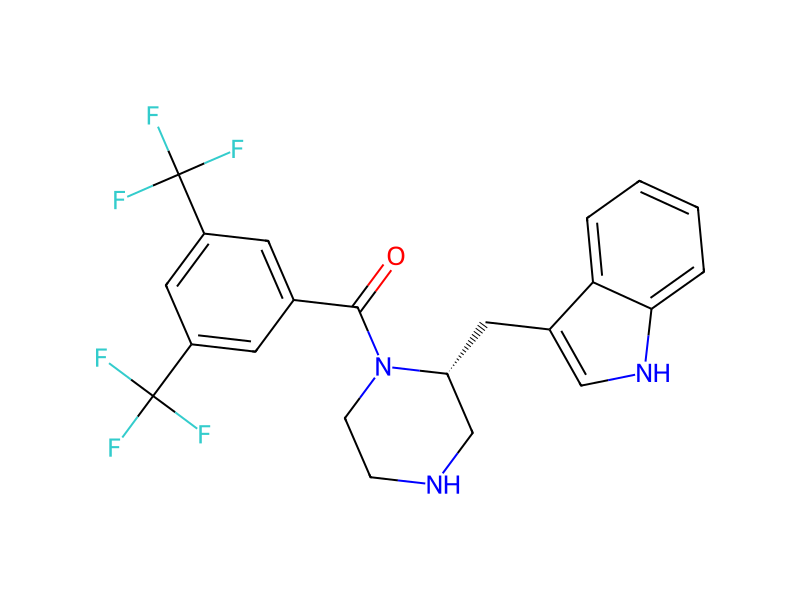
[F:1][C:2]([F:32])([F:31])[C:3]1[CH:4]=[C:5]([CH:24]=[C:25]([C:27]([F:30])([F:29])[F:28])[CH:26]=1)[C:6]([N:8]1[CH2:13][CH2:12][NH:11][CH2:10][C@H:9]1[CH2:14][C:15]1[C:23]2[C:18](=[CH:19][CH:20]=[CH:21][CH:22]=2)[NH:17][CH:16]=1)=[O:7].C(=O)([O-])[O-].[K+].[K+].[C:39](Cl)(=[O:41])[CH3:40]>CN(C)C=O>[C:39]([N:11]1[CH2:12][CH2:13][N:8]([C:6](=[O:7])[C:5]2[CH:4]=[C:3]([C:2]([F:1])([F:31])[F:32])[CH:26]=[C:25]([C:27]([F:28])([F:29])[F:30])[CH:24]=2)[C@H:9]([CH2:14][C:15]2[C:23]3[C:18](=[CH:19][CH:20]=[CH:21][CH:22]=3)[NH:17][CH:16]=2)[CH2:10]1)(=[O:41])[CH3:40]To a stirred mixture of (2R)-1-[3,5-bis(trifluoro-methyl)benzoyl]-2-(1H-indol-3-yl-methyl)piperazine (0.15 g) and potassium carbonate (0.14 g) in dimethylformamide (10 ml) was added acetyl chloride (0.04 ml) at room temperature. After being stirred for 3 hours, the reaction mixture was quenched with water (50 ml) and extracted with dichloromethane (50 ml). The organic layer was washed with aqueous sodium bicarbonate solution and brine, and dried over magnesium sulfate. After evaporation of the solvent, the residue was purified on a silica gel column (10 g) eluting with a mixture of dichloromethane and methanol (20:1). The fractions containing object compound were collected and evaporated under reduced pressure. To the resulting oily product was added a mixed solvent of ethyl ether and diisopropyl ether, and the mixture was concentrated under reduced pressure. The obtained powder was collected by filtration and dried in vacuo to give (2R)-4-acetyl-1-[3,5-bis(trifluoromethyl)benzoyl]-2-(1H-indol-3-yl-methyl) piperazine (0.09 g) as a powder.