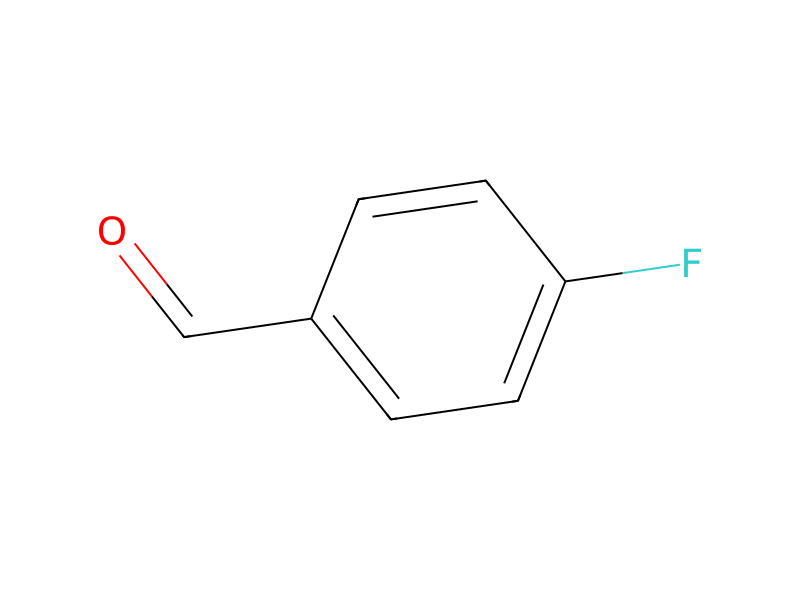
To a solution of 100 g (803 mmol) of p-fluorobenzaldehyde in 400 ml of DMF, 95 g (1377 mmol) of 1-H-1,2,3-triazole and 200 g (1449 mmol) of K2CO3 are added successively and the mixture is stirred for 4 h at 100° C. The mixture is cooled to r.t. and filtrated through celite. The filtrate is concetrated under reduced pressure to give crude crystals which are washed with AcOEt several times. The solid which is not well soluble in AcOEt is washed with water and dried in vacuo to give 4-[1,2,3]-triazol-1-yl-benzaldehyde (B). The filtrate is concentrated under reduced pressure, the obtained solid is solved in CH2Cl2 and then absorbed on silica gel for dry CC (n-Hexane:AcOEt=2:1˜1:2 ) to provide 4-[1,2,3]-triazol-2-yl-benzaldehyde (A) and further compound (B) as pale yellow solids: 1H-NMR (400 MHz, CDCl3): compound A, 7.88 (s, 2H), 8.01 (d, 2H, J=8.56 Hz), 8.29 (d, 2H, J=8.56 Hz), 10.06 (s, 1H); compound B: 7.90 (s, 1H), 7.98 (d, 2H, J=8.56 Hz), 8.07 (d, 2H, J=8.56 Hz), 8.13 (s, 1H), 10.09 (s, 1H).