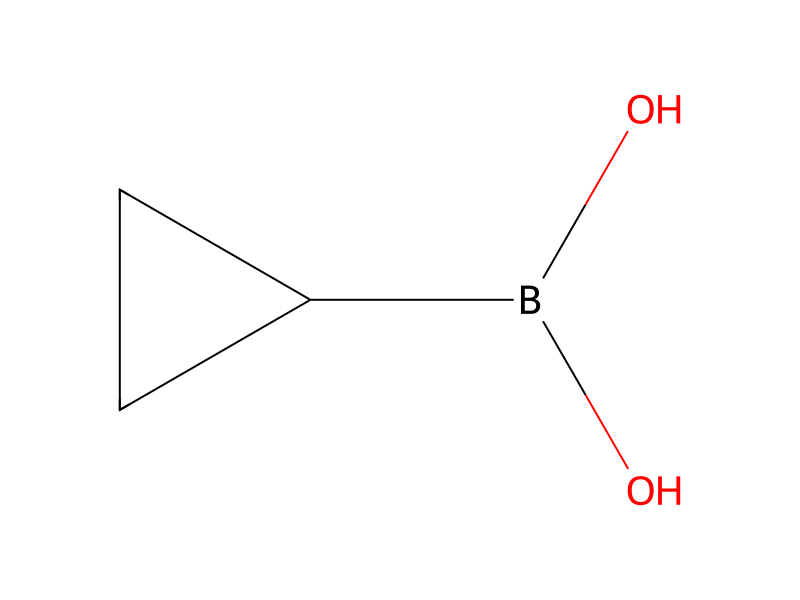
[Cl:1][C:2]1[N:7]=[C:6](Cl)[C:5]([C:9]([O:11][CH3:12])=[O:10])=[CH:4][N:3]=1.[CH:13]1(B(O)O)[CH2:15][CH2:14]1.[O-]P([O-])([O-])=O.[K+].[K+].[K+]>C1COCC1.C1C=CC(P(C2C=CC=CC=2)[C-]2C=CC=C2)=CC=1.C1C=CC(P(C2C=CC=CC=2)[C-]2C=CC=C2)=CC=1.Cl[Pd]Cl.[Fe+2]>[Cl:1][C:2]1[N:7]=[C:6]([CH:13]2[CH2:15][CH2:14]2)[C:5]([C:9]([O:11][CH3:12])=[O:10])=[CH:4][N:3]=1To a solution of methyl 2,4-dichloropyrimidine-5-carboxylate (852 mg, 4 mmol) and cyclopropylboronic acid (344 mg, 4 mmol) in THF (10 mL) was added K3PO4 (3.1 g, 12 mmol) followed by Pd(dppf)Cl2 (292 mg, 0.4 mmol) under N2. The mixture was refluxed for 4 h until the material was disappeared. The reaction mixture was cooled to rt. THF was removed under vacuum. Water (20 mL) was added and the mixture was extracted with EtOAc (20 mL×3). The organic layers were dried over anhydrous Na2SO4, filtered and concentrated under vacuum. The residue was purified by preparative TLC to afford methyl 2-chloro-4-cyclopropylpyrimidine-5-carboxylate (220 mg, 26% yield) as a white solid.