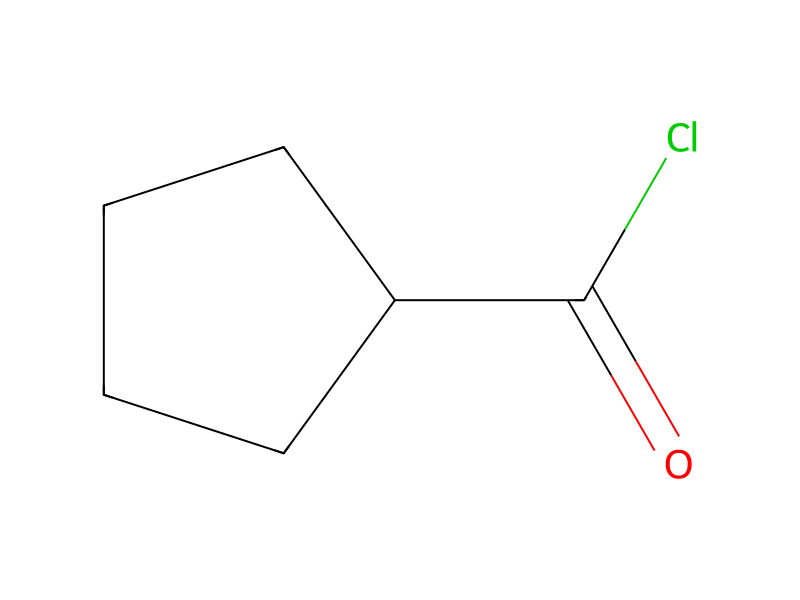
Cl.[NH2:2][C:3]1[C:4]2[C:14]([O:15][CH2:16][C@H:17]3[CH2:22][CH2:21][CH2:20][NH2+:19][CH2:18]3)=[CH:13][CH:12]=[CH:11][C:5]=2[NH:6][S:7](=[O:10])(=[O:9])[N:8]=1.C1COCC1.C([O-])(O)=O.[Na+].[CH:33]1([C:38](Cl)=[O:39])[CH2:37][CH2:36][CH2:35][CH2:34]1>O>[NH2:2][C:3]1[C:4]2[C:14]([O:15][CH2:16][C@H:17]3[CH2:22][CH2:21][CH2:20][N:19]([C:38]([CH:33]4[CH2:37][CH2:36][CH2:35][CH2:34]4)=[O:39])[CH2:18]3)=[CH:13][CH:12]=[CH:11][C:5]=2[NH:6][S:7](=[O:9])(=[O:10])[N:8]=1To a solution of (S)-3-(((4-amino-2,2-dioxido-1H-benzo[c][1,2,6]thiadiazin-5-yl)oxy)methyl)piperidinium hydrochloride (Example 2a, 528 mg, 1.52 mmol) in H2O:THF (20 mL, 2:1), was added NaHCO3 (640 mg, 7.60 mmol). Upon complete dissolution of the NaHCO3, cyclopentanecarbonyl chloride (945 uL, 7.60 mmol) was added dropwise. The reaction was stirred at room temperature overnight. The precipitate was collected by vacuum filtration and purified by preparative HPLC (10-90% acetonitrile in water). The pure fractions were combined, concentrated then dissolved in a solution of NaHCO3 (250 mg in 10 mL water). After complete dissolution, the mixture was cooled in an ice bath and neutralized with 1N HCl. The resulting white solid was collected by vacuum filtration to provide the desired product (322 mg, 52%) as a white solid. H NMR (DMSO-d6, 400 MHz, 80° C.): 1.43 (m, 2H), 1.51-1.80 (m, 10H), 1.90 (m, 1H), 2.09 (m, 1H), 2.96 (m, 2H), 4.01 (br m, 2H), 4.12 (d, J=6.4 Hz, 2H), 6.67 (d, J=7.8 Hz, 1H), 6.77 (d, J=8.3 Hz, 1H), 7.46 (t, J=8.3 Hz, 1H), 7.92 (br s, 2H), 10.70 (br s, 1H). MS=407 (MH+).