Reaction equation

Cc1ccc2ccc(C(F)(F)F)cc2n1>C1=CCCC=CCC1.C1=CCCC=CCC1.CC(C)(C)c1ccnc(-c2cc(C(C)(C)C)ccn2)c1.CC1(C)OB(B2OC(C)(C)C(C)(C)O2)OC1(C)C.COC(C)(C)C.C[OH2+].C[OH2+].[Ir].[Ir]>Cc1cc(B2OC(C)(C)C(C)(C)O2)c2ccc(C(F)(F)F)cc2n1.Cc1ccc2c(B3OC(C)(C)C(C)(C)O3)cc(C(F)(F)F)cc2n1Participants
Reactant 1

Product 2


Reagents, catalysts & solvents 4
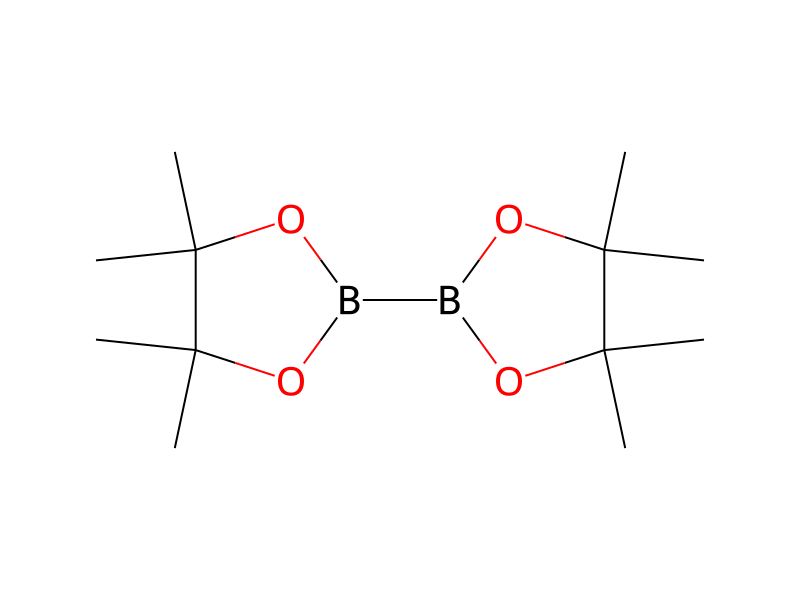



Conditions
- Temperature
- 25 °C
Procedure
General procedure B was applied to 2-methyl-7-(trifluoromethyl)quinoline (211 mg, 1.00mmol). The reaction was stirred at room temperature for 20hours affording 2 monoborylated products in a 70:30 ratio. Volatiles were removed under reduced pressure and the remaining residue was purified by silica gel flash-column chromatography with gradient elution of EtOAc/hexane from 20 -75% over 15 column volumes, to afford with the major isomer (Rf.0.15) 2-methyl-4-(4,4,5,5-tetramethyl-[1,3,2]dioxaborolan-2-yl)-7-(trifluoromethyl)quinoline as a white crystalline solid (219 mg, 65%); m.p.109 -110 °C; Further elution afforded (Rf.0.1) 2-methyl-5-(4,4,5,5-tetramethyl-[1,3,2]dioxaborolan-2-yl)-7-(trifluoro-methyl)quinoline as an off-white solid (91 mg, 27%); m.p.99 -100 °C;
Sources & evidence
- ORD record
- ord-9c8606b8f7b74da2b09422cbd3d40722
- Source dataset
- Borylation dataset from Roche
Linked notes
Loading…