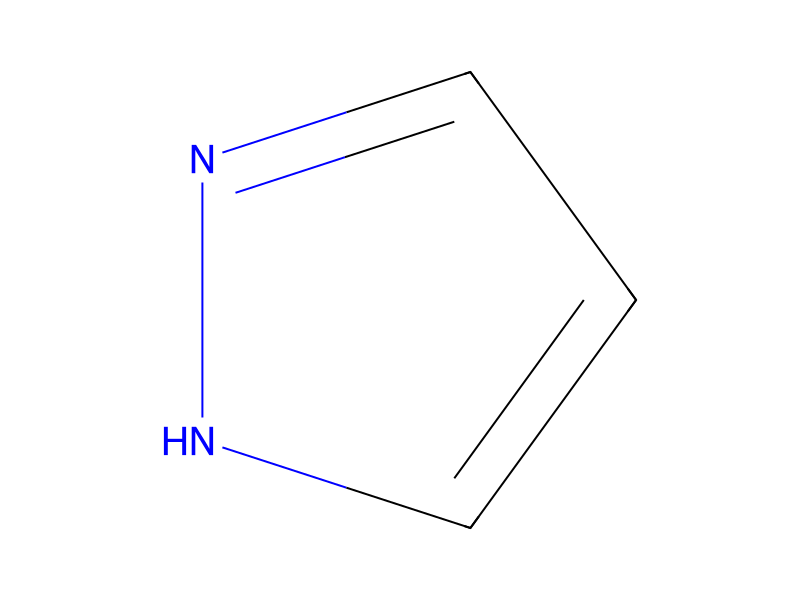
[CH3:1][O:2][C:3]([C:5]1[CH:9]=[CH:8][NH:7][N:6]=1)=[O:4].[H-].[Na+].Cl[C:13]1[CH2:17][C:16]([C:22]2[CH:27]=[C:26]([Cl:28])[CH:25]=[C:24]([Cl:29])[CH:23]=2)([C:18]([F:21])([F:20])[F:19])[O:15][N:14]=1.N1C=CC=N1>C(#N)C>[CH3:1][O:2][C:3]([C:5]1[CH:9]=[CH:8][N:7]([C:13]2[CH2:17][C:16]([C:22]3[CH:27]=[C:26]([Cl:28])[CH:25]=[C:24]([Cl:29])[CH:23]=3)([C:18]([F:19])([F:20])[F:21])[O:15][N:14]=2)[N:6]=1)=[O:4]To a solution of pyrazole-3-carboxylic acid methyl ester (504 mg) in acetonitrile (25 ml) under argon was added sodium hydride (160 mg). The reaction mixture was stirred at room temperature for 1 h. 15 mf of this solution was added dropwise to a solution of chloroisoxazoline of example 17.2 (630 mg) in acetonitrile (10 ml). It was then stirred at room temperature for 1 h; 10 ml of pyrazole solution was added again and the mixture was stirred for 1.5 hour. The reaction was quenched by adding water and dichloromethane. The two layers were separated. The aqueous layer was extracted with dichloromethane. The combined organic layers were washed with brine, dried over sodium sulfate and concentrated. The crude residue was purified by column chromatography (from c-Hex (100%) to c-Hex:EtOAc (80:20)) to afford the title intermediate (680 mg). 1H-NMR (CDCl3, 400 MHz): 8.15 (s, 1H), 7.5 (m, 2H), 7.45 (m, 1H), 4.45 (d, 1H), 4.10 (d, 1H), 3.95 (s, 3H).