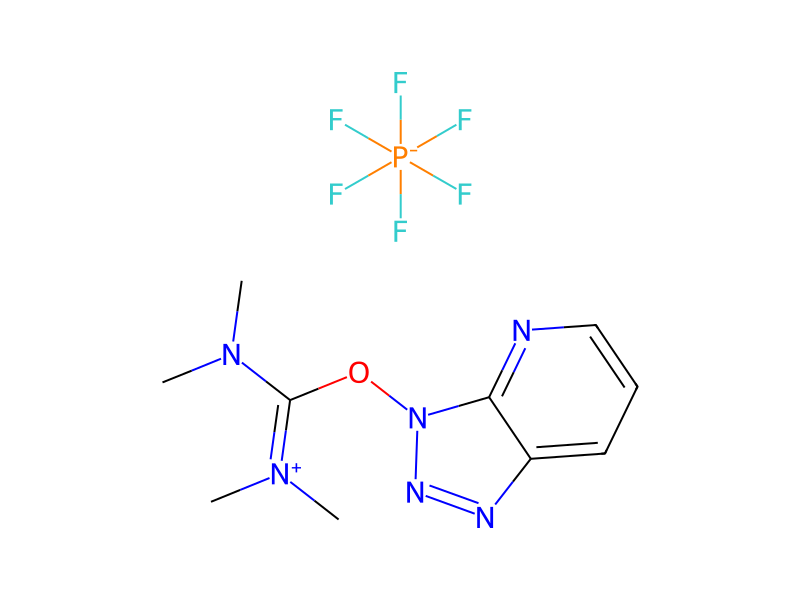
C[N:2](C(ON1N=NC2C=CC=NC1=2)=[N+](C)C)C.F[P-](F)(F)(F)(F)F.[NH2:25][C:26]1[CH:34]=[CH:33][C:29]([C:30]([OH:32])=O)=[CH:28][C:27]=1[N+:35]([O-:37])=[O:36].C(N(CC)CC)C.N[C:46]1[CH:47]=[C:48]([CH3:55])[C:49](C)([CH3:53])[NH:50][C:51]=1C>CN(C=O)C>[NH2:25][C:26]1[CH:34]=[CH:33][C:29]([C:30]([NH:2][C:51]2[CH:46]=[CH:47][C:48]([CH3:55])=[C:49]([CH3:53])[N:50]=2)=[O:32])=[CH:28][C:27]=1[N+:35]([O-:37])=[O:36]To DMF (20 mL) were added HATU (2.87 g, 7.55 mmol), 4-amino-3-nitrobenzoic acid (916 mg, 5.03 mmol), triethylamine (1.05 mL, 762 mmol) and 5-amino-2,3-dimethyllutidine (615 mg, 5.03 mmol) [J. Het. Chem. 31, 1641 (1994)]. The mixture was stirred at ambient temperature for 1 h, then at 80° C. for 18 h. The solution was decanted into ethyl acetate and extracted once with water and five times with brine, then dried, filtered, and the solvent was removed under reduced pressure. The residue was purified by chromatography using a gradient of 80-100% heptane/ethyl acetate to give 4-amino-N-(5,6-dimethylpyridin-2-yl)-3-nitrobenzamide. MS (m/z) 287.0 (M+1).