Triphenylphosphine → 4-[(3,4-Dichlorobenzyl)oxy]-2-fluorobenzo nitrile
Reaction equation

[F:1][C:2]1[CH:9]=[C:8]([OH:10])[CH:7]=[CH:6][C:3]=1[C:4]#[N:5].[Cl:11][C:12]1[CH:13]=[C:14]([CH:17]=[CH:18][C:19]=1[Cl:20])[CH2:15]O.C1(P(C2C=CC=CC=2)C2C=CC=CC=2)C=CC=CC=1.C1(C)C=CC=CC=1.N(C(OCC)=O)=NC(OCC)=O>O1CCCC1>[Cl:11][C:12]1[CH:13]=[C:14]([CH:17]=[CH:18][C:19]=1[Cl:20])[CH2:15][O:10][C:8]1[CH:7]=[CH:6][C:3]([C:4]#[N:5])=[C:2]([F:1])[CH:9]=1Participants
6
Reactant 4



Product 1

Reagents, catalysts & solvents 1

Conditions
- Temperature
- 50 °C
Procedure
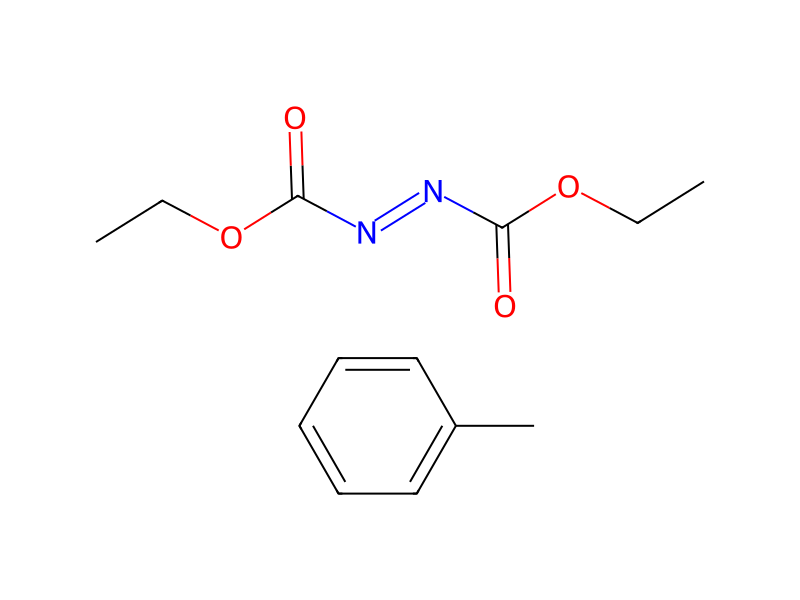
2-Fluoro-4-hydroxybenzonitrile (350 mg, 2.55 mmol) and 3,4-dichlorobenzyl alcohol (542 mg, 3.06 mmol) were dissolved in tetrahydrofuran (7.0 mL), and triphenylphosphine (803 mg, 3.06 mmol) and a 40% diethyl azodicarboxylate toluene solution (1.40 mL, 3.06 mmol) were added thereto at room temperature, and then, the resulting mixture was stirred under a nitrogen atmosphere at 50° C. for 5 hours. After the reaction solution was cooled to room temperature, the solvent was distilled off under reduced pressure, and the resulting residue was purified by silica gel column chromatography (hexane:ethyl acetate=100:0 to 65:35 (v/v)), whereby the objective title compound was obtained as a white solid (676 mg, yield: 89%).
Workup
- temperatureAfter the reaction solution was cooled to room temperature
- distillationthe solvent was distilled off under reduced pressure
- customthe resulting residue was purified by silica gel column chromatography (hexane:ethyl acetate=100:0 to 65:35 (v/v)), whereby the objective title compound
Sources & evidence
- ORD record
- ord-6660fa077c184d5ea64363e0bf198eb6
- Source dataset
- uspto-grants-2012_07
- Patent number
- US08222281B2
Reaction notes
Loading…