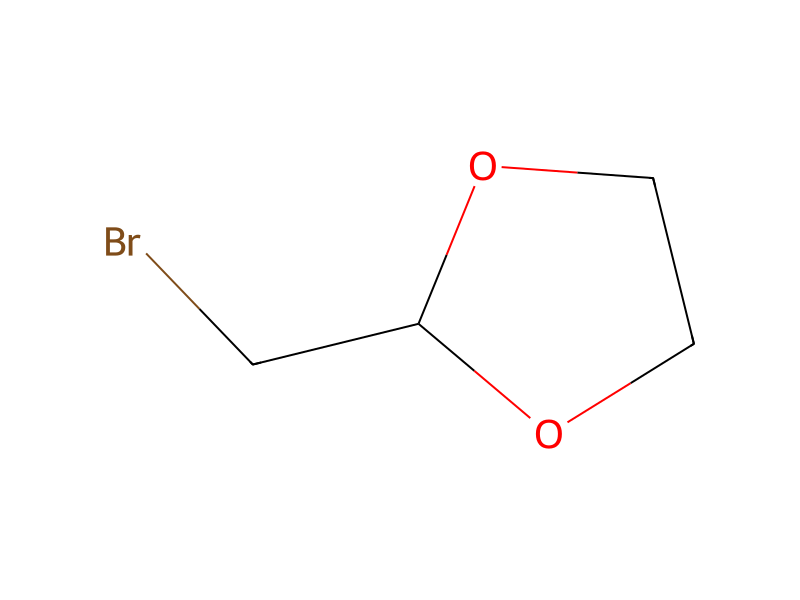
To a mixture of 2-bromothiophenol (5 g) and 2-bromomethyl-1,3-dioxolane (2.98 mL) in N,N-dimethylformamide (50 mL) was added potassium carbonate (5.48 g) at room temperature, and the mixture was stirred overnight. The reaction mixture was poured into water, and the mixture was extracted with diethyl ether. The extract washed with water, 1 mol/L sodium hydroxide aqueous solution, water and brine successively, and dried over anhydrous magnesium sulfate, and the solvent was removed under reduced pressure to give (2-bromophenylthiomethyl)-1,3-dioxolane (7.25 g). To a mixture of poly phosphoric acid (20 g) and chlorobenzene (40 mL) was added a solution of (2-bromophenylthiomethyl)-1,3-dioxolene (7.25 g) in chlorobenzene (20 mL), and the mixture was refluxed for 8 hours. The reaction mixture was cooled to room temperature and supernatant solution was collected by decantation. Toluene was added to the residue, and the supernatant was collected by decantation after the mixture was stirred. The supernatant was combined and concentrated under reduced pressure. The residue was dissolved in ethyl acetate, and the solution washed with a saturated sodium hydrogencarbonate aqueous solution, water and brine and dried over anhydrous magnesium sulfate, and the solvent was removed under reduced pressure. The residue was purified by column chromatography on silica gel (eluent: n-hexane) to give the title compound (2.27 g).