Reaction equation

[C:1]([O-:4])(=[O:3])[CH3:2].[K+].[Cl:6][C:7]1[CH:14]=[CH:13][CH:12]=[CH:11][C:8]=1[CH:9]=O.C(OC(=O)C)(=O)C.[OH-].[Na+]>C1(C)C=CC=CC=1>[Cl:6][C:7]1[CH:14]=[CH:13][CH:12]=[CH:11][C:8]=1[CH:9]=[CH:2][C:1]([OH:4])=[O:3]Participants
Reactant 4
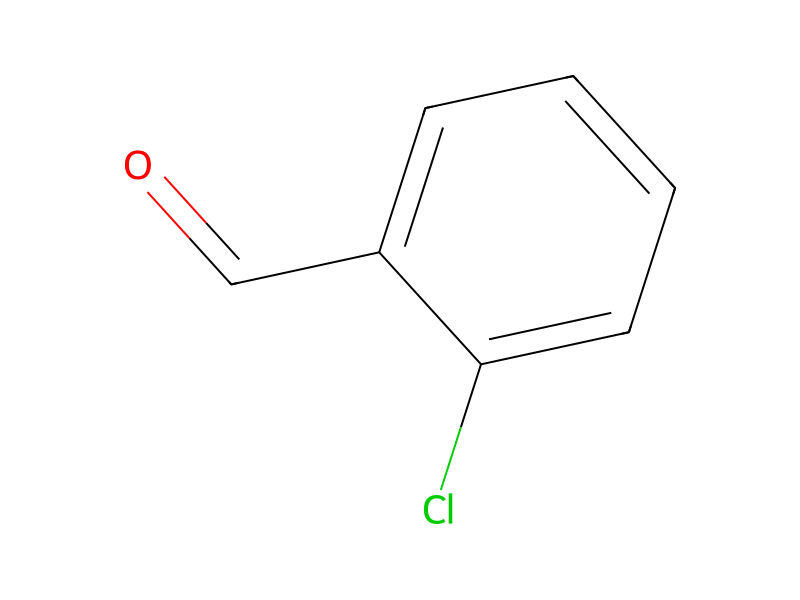



Product 1

Reagents, catalysts & solvents 1

Conditions
- Temperature
- 145 °C
Procedure
A mixture of 18.4 g (0.19 mol) of potassium acetate in 70.3 g (0.5 mol) 2-chlorobenzaldehyde is heated to 145° C. Next 76.5 g (0.75 mol) of acetic anhydride is added in 1 hour. After dosing of 0.50 mol of acetic anhydride the mixture became clear. The mixture is stirred at 145° C. during 18 hours. The hot reaction mixture is poured into a mixture of 670 g of 6.4 w/w % aqueous NaOH (1.1 mol, 2.1 eq based on 2-chlorobenzaldehyde) and 200 mL toluene at 80° C. The final pH was 7.4. After separation of the organic phase, the water layer is again extracted with 100 mL of toluene at 80° C. The combined water phases are acidified with 380 g of 25 w/w % H2SO4 to pH 4.6. Crystallization starts at pH 6.4. The mixture is cooled to 25° C. and the product is isolated by filtration, washed with 100 mL of water and dried (vacuo, 50° C.). 3-(2-chloro-phenyl)-acrylic acid was obtained as an off white solid (100.2 g, 0.55 mol, yield 55%).
Workup
- customAfter separation of the organic phase
- extractionthe water layer is again extracted with 100 mL of toluene at 80° C
- customCrystallization
- temperatureThe mixture is cooled to 25° C.
- customthe product is isolated by filtration
- washwashed with 100 mL of water
- customdried (vacuo, 50° C.)
Sources & evidence
- ORD record
- ord-e862e1156e4a4a7796b47dac015c698e
- Source dataset
- uspto-grants-2010_06
- Patent number
- US07732621B2
Linked notes
Loading…