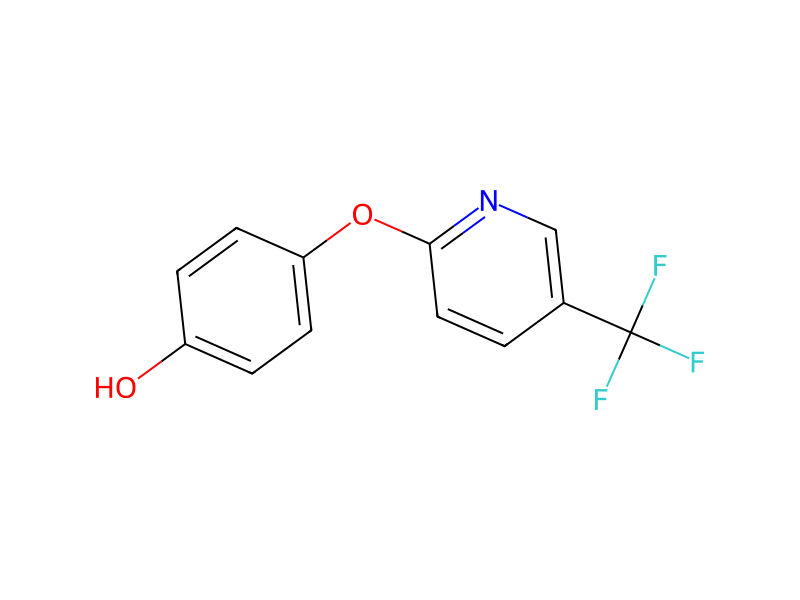
Cl[CH:2]([CH3:6])[C:3]([OH:5])=[O:4].[F:7][C:8]([F:24])([F:23])[C:9]1[CH:10]=[CH:11][C:12]([O:15][C:16]2[CH:21]=[CH:20][C:19]([OH:22])=[CH:18][CH:17]=2)=[N:13][CH:14]=1.[OH-].[Na+]>C1(C)C(C)=CC=CC=1.O>[F:24][C:8]([F:7])([F:23])[C:9]1[CH:10]=[CH:11][C:12]([O:15][C:16]2[CH:17]=[CH:18][C:19]([O:22][CH:2]([CH3:6])[C:3]([OH:5])=[O:4])=[CH:20][CH:21]=2)=[N:13][CH:14]=1100.0 g (0.92 mol) of (RS)-(+)-2-chloropropionic acid are added to the solution of 192.0 g (0.75 mol) of 4-(5-trifluoromethyl-2-pyridyloxy)phenol in 900 g (about 1050 ml) of xylene. The temperature of the reaction mixture is elevated to 80° C. and 78.0 g (1.95 mol) of sodium hydroxide dissolved in water are added dropwise under such a reduced pressure (about 36 kPa) that the mixture boils at 90° C. The water formed in the reaction is continuously distilled off while maintaining the boiling temperature at 90° C. After the addition, the reaction mixture is stirred at 90° C. for additional 15 minutes, then the reduced pressure is ceased. After adding 300 ml of water to the mixture and stirring at 85° C. for 10 minutes, it is acidified by adding phosphoric acid and the phases are separated. The xylene layer is dried, treated with activated charcoal and finally evaporated to dryness.