HomeMCPWorkbenchSkills
HomeWorkbenchNotificationsMe
llms.txt · MCP GuidePrivacy Policy · Terms of Service · Supportv1.8.3
  1. Home
  2. /Reaction

Benzenepropanoic acid → 4-(2-Hydroxyethyl)-1-(3-phenylpropionyl)piperidine

HRID 1599472
Print

Reaction equation

HRID 1599472 reaction equation
[C:1]1([CH2:7][CH2:8][C:9]([OH:11])=O)[CH:6]=[CH:5][CH:4]=[CH:3][CH:2]=1.S(Cl)(Cl)=O.[NH:16]1[CH2:21][CH2:20][CH:19]([CH2:22][CH2:23][OH:24])[CH2:18][CH2:17]1.C(N(CC)CC)C>C1(C)C=CC=CC=1.ClCCl>[OH:24][CH2:23][CH2:22][CH:19]1[CH2:20][CH2:21][N:16]([C:9](=[O:11])[CH2:8][CH2:7][C:1]2[CH:2]=[CH:3][CH:4]=[CH:5][CH:6]=2)[CH2:17][CH2:18]1
ParticipantsConditionsProcedureWorkupSources & evidenceReaction notes

Participants

7

Reactant 4

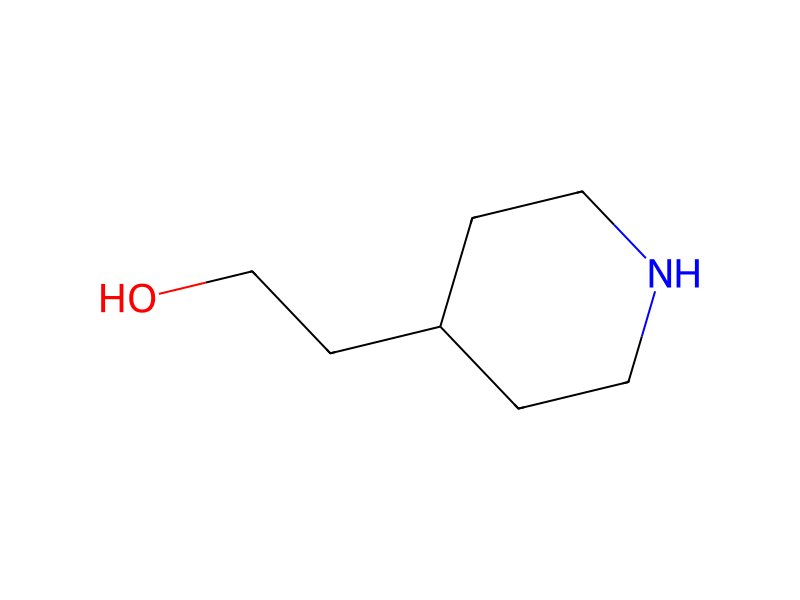
HCID 107Benzenepropanoic acidHCID 8471TriethylamineHCID 24386Thionyl ChlorideHCID 739534-Piperidineethanol

Product 1

HCID 189287334-(2-Hydroxyethyl)-1-(3-phenylpropionyl)piperidine

Reagents, catalysts & solvents 2

HCID 1140Toluene
Solvent
HCID 6344DichloromethaneSolvent2×

Conditions

Temperature
0 °C

Procedure

A mixture of 3-phenylpropionic acid (29.5 g) and thionyl chloride (35 ml) in dry toluene (100 ml) was heated under reflux at 80°-100° C. for two hours. The mixture was then evaporated. The residue was treated with two portions of toluene and the resultant solution was evaporated on each occasion yielding an oil which was then dissolved in dry dichloromethane (50 ml). The solution was added dropwise to a stirred solution of 4-piperidine-ethanol (25.2 g) and triethylamine (22.2 g) in dichloromethane (250 ml) at 0° C. over one hour, maintaining the temperature at 0° C. The mixture was allowed to warm to 20° C. and was stirred for 18 hours and then washed with saturated sodium bicarbonate solution. The organic layer was separated and evaporated to dryness. The residue was dissolved in dioxan (20 ml) and 1M sodium hydroxide solution (20 ml) was then added. The solution was stirred at 20° C. for 20 hours and then stirred at 40° C. for a further 4 hours. The solution was evaporated and the residue treated with dilute sodium hydroxide solution and then extracted with ethyl acetate. The combined ethyl acetate extracts were washed (dilute hydrochloric acid, brine), dried and evaporated to give 4-(2-hydroxyethyl)-1-(3-phenylpropionyl)piperidine as an oil.

Workup

  1. temperaturewas heated
  2. temperatureunder reflux at 80°-100° C. for two hours
  3. customThe mixture was then evaporated
  4. additionThe residue was treated with two portions of toluene
  5. customthe resultant solution was evaporated on each occasion
  6. customyielding an oil which
  7. temperatureto warm to 20° C.
  8. washwashed with saturated sodium bicarbonate solution
  9. customThe organic layer was separated
  10. customevaporated to dryness
  11. dissolutionThe residue was dissolved in dioxan (20 ml)
  12. addition1M sodium hydroxide solution (20 ml) was then added
  13. stirringThe solution was stirred at 20° C. for 20 hours
  14. stirringstirred at 40° C. for a further 4 hours
  15. customThe solution was evaporated
  16. additionthe residue treated with dilute sodium hydroxide solution
  17. extractionextracted with ethyl acetate
  18. washThe combined ethyl acetate extracts were washed (dilute hydrochloric acid, brine)
  19. customdried
  20. customevaporated

Sources & evidence

ORD record
ord-d3dc09ebf4b842bba6a4a1699cb61eb2
Source dataset
uspto-grants-1998_04
DOI
10.6084/m9.figshare.5104873.v1
Patent number
US05741800

Reaction notes

On this pageParticipantsConditionsProcedureWorkupSources & evidenceReaction notes