HomeMCPWorkbenchSkills
HomeWorkbenchNotificationsMe
llms.txt · MCP GuidePrivacy Policy · Terms of Service · Supportv1.8.3
  1. Home
  2. /Reaction

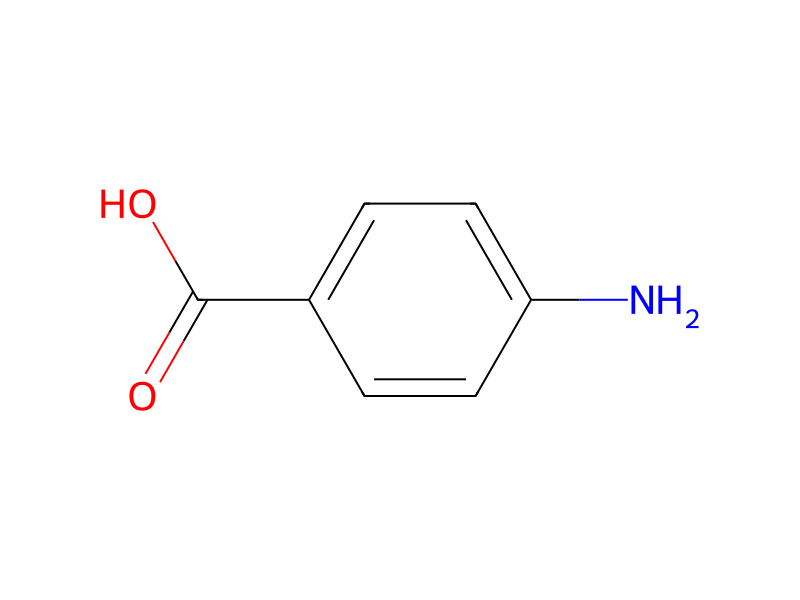
4-Aminobenzoic Acid → 4-(N-((2,4-diamino-6-pteridinyl)methyl)amino)benzoic acid

HRID 1611596
Print

Reaction equation

HRID 1611596 reaction equation
C1(P(C2C=CC=CC=2)C2C=CC=CC=2)C=CC=CC=1.BrBr.[NH2:22][C:23]1[N:32]=[C:31]([NH2:33])[C:30]2[C:25](=[N:26][CH:27]=[C:28]([CH2:34]O)[N:29]=2)[N:24]=1.[O-2].[Ba+2].[NH2:38][C:39]1[CH:47]=[CH:46][C:42]([C:43]([OH:45])=[O:44])=[CH:41][CH:40]=1>O.CO.C(Cl)Cl.CC(N(C)C)=O>[CH:41]1[C:42]([C:43]([OH:45])=[O:44])=[CH:46][CH:47]=[C:39]([NH:38][CH2:34][C:28]2[N:29]=[C:30]3[C:31]([NH2:33])=[N:32][C:23]([NH2:22])=[N:24][C:25]3=[N:26][CH:27]=2)[CH:40]=1
ParticipantsConditionsProcedureWorkupSources & evidenceReaction notes

Participants

10

Reactant 5

HCID 9784-Aminobenzoic AcidHCID 11776TriphenylphosphineHCID 24408BromineHCID 703472,4-Diamino-6-hydroxymethylpteridineHCID 9855530Barium Oxide Nanoparticle Dispersion

Product 1

HCID 1697484-(N-((2,4-diamino-6-pteridinyl)methyl)amino)benzoic acid
Yield 99%

Reagents, catalysts & solvents 4

HCID 887MethanolSolvent2×HCID 962WaterSolventHCID 6344DichloromethaneSolventHCID 31374DimethylacetamideSolvent

Conditions

Temperature
5 °C

Procedure

To a 2 L 3-necked round bottom flask, equipped with a dropping funnel, a thermometer, and a drying tube, were added triphenylphosphine (216 g, 0.83 mol) and anhydrous dimethylacetamide (0.66 L). The resulting clear solution was cooled to 5° C. and bromine (132 g, 0.83 mol) was added over 45 min while maintaining the temperature below 8° C. To the resulting white slurry was added 2,4-diamino-6-hydroxymethyl pteridine (53 g, 0.28 mol). The temperature rose to 35° C. due to exothermic effect. The rust colored slurry slowly dissolved over 1 h to become a dark red solution. The mixture was stirred at ambient temperature overnight (ca. 17 h) forming a dark red slurry. Barium oxide (53 g, 0.35 mol) and 4-aminobenzoic acid (57 g, 0.42 mol) were added in one portion each with vigorous stirring. The temperature rose to 70° C. due to exothermic effect and the mixture turned to a rust-colored slurry within 15 min. The reaction mixture was stirred at 55±2° C. for 24±2 h. The resulting yellow-brown slurry was cooled to 20° C., then poured into a mixture of CH2Cl2 (6.9 L) and MeOH (0.2 L). The solids were isolated by filtration, slurried in H2O (2.5 L), and the mixture was filtered again to isolate the solids. The solids were slurried in MeOH (2.5 L), isolated by filtration, and air-dried at ambient temperature, to give 85 g (99%) of crude product as a brownish-yellow powder, Lot BM-02G-54.

Workup

  1. customTo a 2 L 3-necked round bottom flask, equipped with a dropping funnel
  2. temperaturewhile maintaining the temperature below 8° C
  3. customrose to 35° C. due to exothermic effect
  4. customforming a dark red slurry
  5. customrose to 70° C. due to exothermic effect
  6. stirringThe reaction mixture was stirred at 55±2° C. for 24±2 h
  7. temperatureThe resulting yellow-brown slurry was cooled to 20° C.
  8. customThe solids were isolated by filtration
  9. filtrationthe mixture was filtered again
  10. customto isolate the solids
  11. customisolated by filtration
  12. customair-dried at ambient temperature

Sources & evidence

ORD record
ord-8da75c23c8b5400b9ae089491ded9839
Source dataset
uspto-grants-2006_01
DOI
10.6084/m9.figshare.5104873.v1
Patent number
US06989386B2

Reaction notes

On this pageParticipantsConditionsProcedureWorkupSources & evidenceReaction notes




