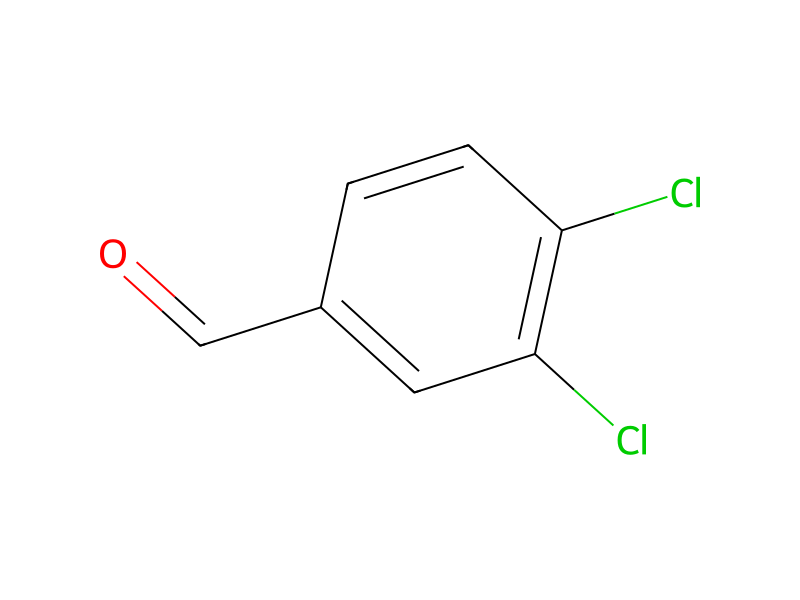
[Br:1][C:2]1[S:6][C:5]([C:7](=[O:13])[CH2:8][C:9]([O:11][CH3:12])=[O:10])=[CH:4][CH:3]=1.[Cl:14][C:15]1[CH:16]=[C:17]([CH:20]=[CH:21][C:22]=1[Cl:23])[CH:18]=O.N1CCCCC1.C(O)(=O)C>C1C=CC=CC=1>[Br:1][C:2]1[S:6][C:5]([C:7](/[C:8](=[CH:18]/[C:17]2[CH:20]=[CH:21][C:22]([Cl:23])=[C:15]([Cl:14])[CH:16]=2)/[C:9]([O:11][CH3:12])=[O:10])=[O:13])=[CH:4][CH:3]=1To a 250 mL round bottom flask was added a solution of methyl 3-(5-bromo-2-thienyl)-3-oxopropanoate (25.11 g, 95.44 mmol), 3,4-dichloro-benzaldehyde (21.71 g, 124.1 mmol) and piperidine (0.944 mL, 9.54 mmol) in anhydrous benzene (682 mL). Acetic acid (3.80 mL, 66.8 mmol) was added and the reaction mixture was fitted with a Dean-Stark trap. The oil bath was heated to 110° C. and the reaction stirred at reflux for 18 hours. The reaction was cooled to ambient temperature and concentrated under reduced pressure. The crude material was dry loaded onto silica gel and purified by silica gel chromatography to afford the product as a yellow oil (36.7 g, 91.6%). LCMS: (AA) ES+: 421. 1H NMR (400 MHz, d6-DMSO) δ 7.83 (s, 1H), 7.53-7.45 (m, 1H), 7.34 (t, J=10.0 Hz, 1H), 7.24 (dd, J=8.4, 2.7 Hz, 2H), 7.03 (d, J=4.1 Hz, 1H), 3.81 (s, 3H).