Reaction equation
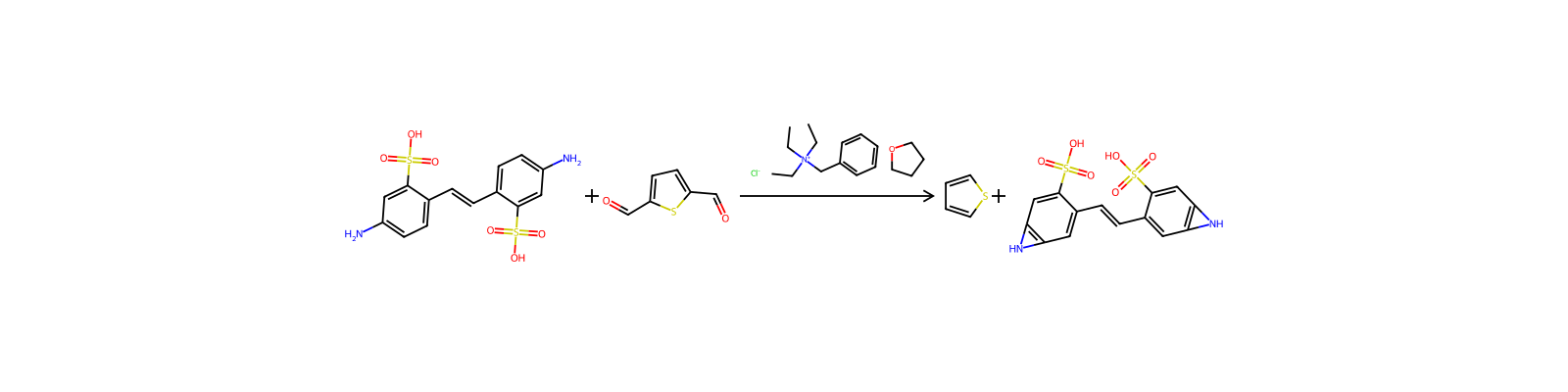
[NH2:1][C:2]1[CH:3]=[C:4]([S:21]([OH:24])(=[O:23])=[O:22])[C:5]([CH:8]=[CH:9][C:10]2[C:11]([S:17]([OH:20])(=[O:19])=[O:18])=[CH:12][C:13]([NH2:16])=[CH:14][CH:15]=2)=[CH:6][CH:7]=1.S1C(C=O)=CC=C1C=O>[Cl-].C([N+](CC)(CC)CC)C1C=CC=CC=1.C1COCC1>[S:21]1[CH:4]=[CH:5][CH:6]=[CH:7]1.[NH:1]1[C:7]2[CH:6]=[C:5]([CH:8]=[CH:9][C:10]3[C:11]([S:17]([OH:20])(=[O:19])=[O:18])=[CH:12][C:13]4[NH:16][C:14]=4[CH:15]=3)[C:4]([S:21]([OH:24])(=[O:23])=[O:22])=[CH:3][C:2]1=2Participants



Procedure
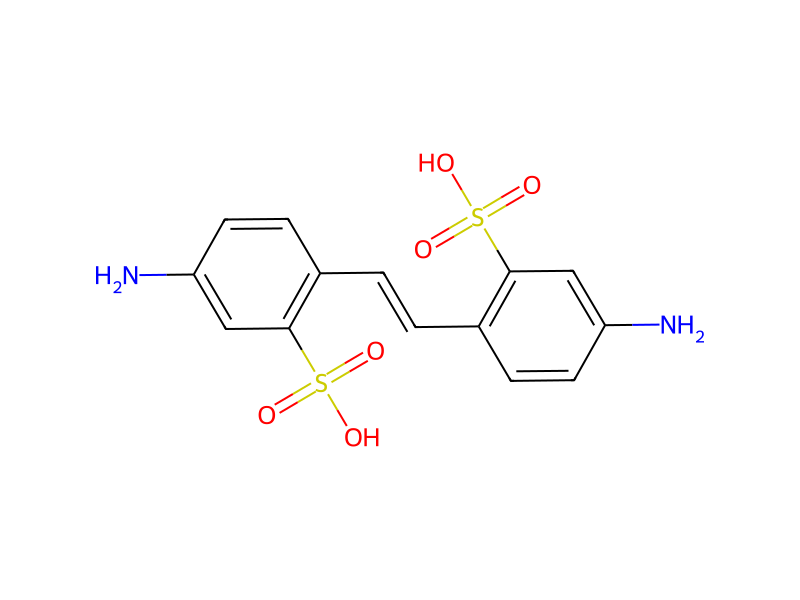
A volume of 60 ml distilled water and a few drops of 2M sodium hydroxide was required to dissolve the commercially available 4,4′-diaminostilbene-2,2′-disulfonic acid (155 mg, 0.41 mmol). After the addition of 40 ml THF, 2,5-thiophene dicarboxaldehyde (58 mg, 0.42 mmol) was added along with a catalytic amount of benzyltriethyl ammonium chloride. The red coloured solution was stirred at room temperature for two days. The solvent was removed under reduced pressure to afford the polymer as a red solid that was recrystallized from ethanol. λmax (water): 305 and 338 nm. Mw=148 094, PDI=2.3, DP=286. 1H-NMR (200 MHz, [D] DMSO): δ=8.92 (br, s, 2H), 8.21 (br, s, 2H), 7.80 (br, s, 6H), 7.39 (br, s, 2H). Anal. cald. C20H12O6N2S3Na2.7.2H2O: C, 37.06, H, 4.11, N, 4.32, S, 14.84 found C, 37.27; H, 3.90; N, 4.28, S, 14.62. The 1S0,0-0S0,0 (HOMO-LUMO) transition was calculated to be 65 kcal/mol (2.83 eV). From the absorption onset in the red region of the spectrum, a value can be calculated for the band gap of 51.3 kcal/mol (2.23 eV) for 9.
Workup
- distillationA volume of 60 ml distilled water and a few drops of 2M sodium hydroxide
- customThe solvent was removed under reduced pressure
Sources & evidence
- ORD record
- ord-636228932e6e45e0b72049fa8690af44
- Source dataset
- uspto-grants-2011_10
- Patent number
- US08034895B2
Linked notes
Loading…