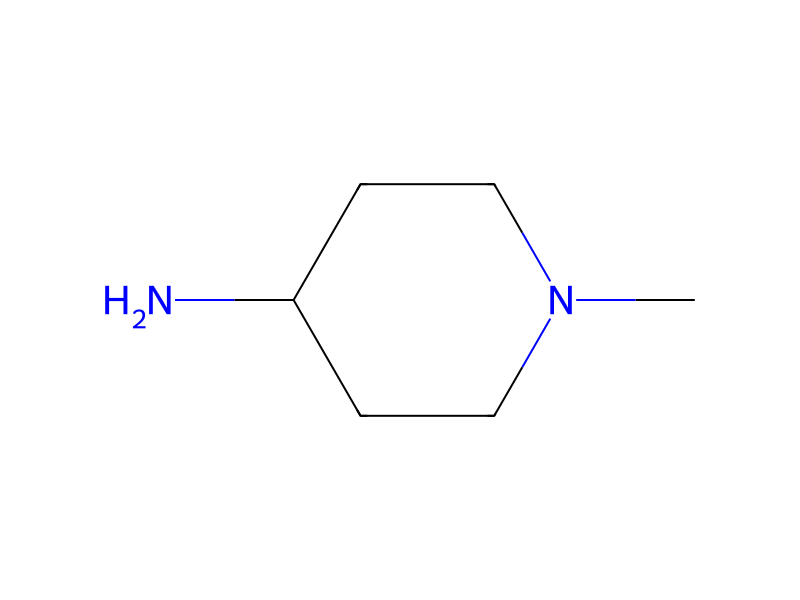
[NH2:1][C:2]1[CH:10]=[CH:9][C:5]([C:6]([OH:8])=O)=[CH:4][C:3]=1[Cl:11].[NH2:12][CH:13]1[CH2:18][CH2:17][N:16]([CH3:19])[CH2:15][CH2:14]1.C(N(C(C)C)C(C)C)C>CN(C)C=O.C(=O)([O-])[O-].[Na+].[Na+]>[NH2:1][C:2]1[CH:10]=[CH:9][C:5]([C:6]([NH:12][CH:13]2[CH2:18][CH2:17][N:16]([CH3:19])[CH2:15][CH2:14]2)=[O:8])=[CH:4][C:3]=1[Cl:11]To a solution of 1.0 g (5.9 mole) of 4-amino-3-chlorobenzoic acid, 0.8 g (7.0 mole) of 4-amino-1-methyl-piperidine and 4.14 mL (23 mmole) of ethyldiisopropyl amine in 20 mL of dimethylformamide was added a solution of 2.4 g (6.4 mole) of 1-(di-1-pyrrolidinylmethylene)-1H-benzotriazolium 3-oxide hexafluorophosphate in 5 mL of dimethylformamide. The mixture was stirred at room temperature for 2 hours, then diluted with ice water and saturated sodium carbonate. The mixture was extracted with ethyl acetate twice. The combined organic layers were washed three times with sodium carbonate, three times with brine, dried over anhydrous sodium sulfate, filtered and concentrated under reduced pressure. Purification by silica gel chromatography, eluting with dichloromethane-methanol (gradient, 100:0-60:40) gave 1.41 g of 4-amino-3-chloro-N-(1-methyl-piperidin-4-yl)-benzamide as a solid.