HomeMCPSkillsWorkbenchOpenChem
HomeWorkbenchNotificationsMe
llms.txt · skill.md · MCP GuidePrivacy Policy · Terms of Service · Supportv1.8.5
  1. Home
  2. /Reaction

Triphenylphosphine → 1'-pentylspiro[furo[2,3-f][1,3]benzodioxole-7,3'-pyrrolo[3,2-b]pyridin]-2'(1'H)-one

HRID 1715223
Print

Reaction equation

O[C:2]1[C:3]([C:11]2([CH2:26][OH:27])[C:15]3=[N:16][CH:17]=[CH:18][CH:19]=[C:14]3[N:13]([CH2:20][CH2:21][CH2:22][CH2:23][CH3:24])[C:12]2=[O:25])=[CH:4][C:5]2[O:9][CH2:8][O:7][C:6]=2[CH:10]=1.C1(P(C2C=CC=CC=2)C2C=CC=CC=2)C=CC=CC=1.N(C(OC(C)C)=O)=NC(OC(C)C)=O>O1CCCC1>[CH2:20]([N:13]1[C:14]2[C:15](=[N:16][CH:17]=[CH:18][CH:19]=2)[C:11]2([C:3]3=[CH:4][C:5]4[O:9][CH2:8][O:7][C:6]=4[CH:10]=[C:2]3[O:27][CH2:26]2)[C:12]1=[O:25])[CH2:21][CH2:22][CH2:23][CH3:24]
ParticipantsProcedureWorkupSources & evidenceReaction notes

Participants

5

Reactant 3

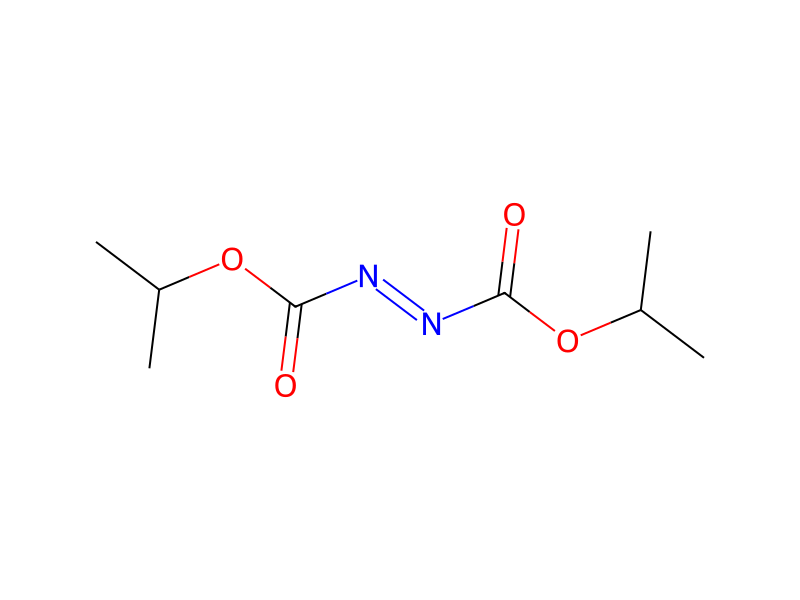
HCID 11776TriphenylphosphineHCID 75555Diisopropyl diazene-1,2-dicarboxylateHCID 119628133-(6-hydroxy-1,3-benzodioxol-5-yl)-3-(hydroxymethyl)-1-Pentyl-1,3-dihydro-2H-pyrrolo[3,2-b]pyridin-2-one

Product 1

HCID 119981901'-pentylspiro[furo[2,3-f][1,3]benzodioxole-7,3'-pyrrolo[3,2-b]pyridin]-2'(1'H)-oneYield 72.5%

Reagents, catalysts & solvents 1

HCID 8028
Tetrahydrofuran
Solvent

Procedure

To a solution 3-(6-hydroxy-1,3-benzodioxol-5-yl)-3-(hydroxymethyl)-1-pentyl-1,3-dihydro-2H-pyrrolo[3,2-b]pyridin-2-one (1.95 g, 4.70 mmol) in anhydrous tetrahydrofuran (30.0 mL) was added triphenylphosphine (2.06 g, 7.88 mmol) and diisopropyl azodicarboxylate (1.59 g, 7.88 mmol) at 0° C. The reaction mixture was stirred at ambient temperature for 16 h and quenched with saturated ammonium chloride (20.0 mL). After the solvent was removed under reduced pressure, the residue was diluted with ethyl acetate (30.0 mL). The organic layer was washed with brine (3×15.0 mL), dried over anhydrous sodium sulfate and filtered. The filtrate was concentrated in vacuo to dryness. The residue was subjected to silica gel column chromatography eluting with ethyl acetate/hexane (35%) to give 1.20 g of yellow solid, which was further purified on HPLC with a reverse phase column to afford the title compound (0.09 g, 8%) as a yellow solid: 1H NMR (300 MHz, CDCl3) δ 8.21 (dd, 1H), 7.21-7.12 (m, 2H), 6.50 (s, 1H), 6.07 (s, 1H), 5.83 (d, 1H), 4.88 (s, 2H), 3.88-3.78 (m, 1H), 3.70-3.60 (m, 1H), 1.75-1.65 (m, 2H), 1.37-1.32 (m, 4H), 0.89 (t, 3H); 13C NMR (75 MHz, CDCl3) δ 175.9, 156.4, 152.7, 149.1, 143.9, 142.3, 137.8, 123.4, 117.8, 114.9, 102.6, 101.5, 94.0, 78.3, 58.7, 40.2, 29.0, 27.0, 22.3, 14.0; MS (ES+) m/z 353.3 (M+1).


Workup

  1. customquenched with saturated ammonium chloride (20.0 mL)
  2. customAfter the solvent was removed under reduced pressure
  3. additionthe residue was diluted with ethyl acetate (30.0 mL)
  4. washThe organic layer was washed with brine (3×15.0 mL)
  5. dry with materialdried over anhydrous sodium sulfate
  6. filtrationfiltered
  7. concentrationThe filtrate was concentrated in vacuo to dryness
  8. washeluting with ethyl acetate/hexane (35%)

Sources & evidence

ORD record
ord-2ec0c69fc7604996bd3af277ab9f701c
Source dataset
uspto-grants-2010_09
DOI
10.6084/m9.figshare.5104873.v1
Patent number
US07799798B2

Reaction notes

On this pageParticipantsProcedureWorkupSources & evidenceReaction notes