Reaction equation

[NH2:1][C:2]1[C:11]2[C:6](=[CH:7][C:8]([O:14][CH3:15])=[C:9]([O:12][CH3:13])[CH:10]=2)[N:5]=[C:4]([N:16]2[CH2:21][CH2:20][N:19]([C:22]([CH:24]3[CH2:28][CH2:27][CH2:26][O:25]3)=[O:23])[CH2:18][CH2:17]2)[N:3]=1.[ClH:29]>>[OH2:12].[OH2:12].[ClH:29].[NH2:1][C:2]1[C:11]2[C:6](=[CH:7][C:8]([O:14][CH3:15])=[C:9]([O:12][CH3:13])[CH:10]=2)[N:5]=[C:4]([N:16]2[CH2:21][CH2:20][N:19]([C:22]([CH:24]3[CH2:28][CH2:27][CH2:26][O:25]3)=[O:23])[CH2:18][CH2:17]2)[N:3]=1Participants
3
Reactant 2

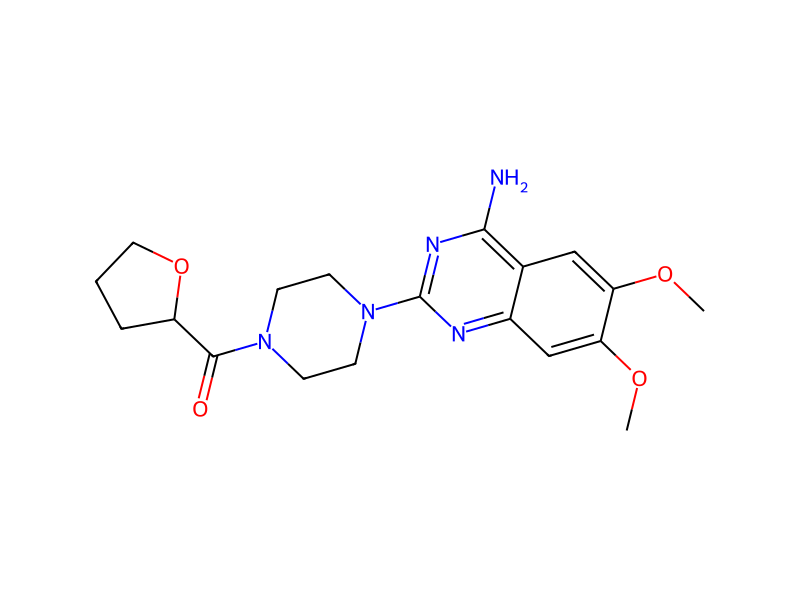
Product 1

Conditions
- Temperature
- 35 °C
Procedure
The hydrochloride salt of the dihydrate of the compound prepared as described above in Step 1 was prepared by slurrying 10 grams (0.026 mol) of the above-prepared 1-(4-amino-6,7-dimethoxy-2-quinazolinyl)-4-(2-tetrahydrofuroyl)-piperazine in 150 ml of 190 proof Formula 3A alcohol, heating the slurry to about 35° C., adding 2.5 ml of concentrated aqueous hydrochloric acid, and heating the mixture to about 70° C. The reaction mixture was carbon treated, the carbon was filtered off and the filtrate was cooled overnight in an icebox. The product was then filtered off and dried at 60° C. to obtain 8.3 grams (0.018 tool, 69%) of the desired product.
Workup
- customwas prepared
- temperatureheating the mixture to about 70° C
- additiontreated
- filtrationthe carbon was filtered off
- temperaturethe filtrate was cooled overnight in an icebox
- filtrationThe product was then filtered off
- customdried at 60° C.
Sources & evidence
- ORD record
- ord-10246e0e753248eba169c713ebf2f2a2
- Source dataset
- uspto-grants-1996_04
- Patent number
- US05504207
Linked notes
Loading…