Reaction equation

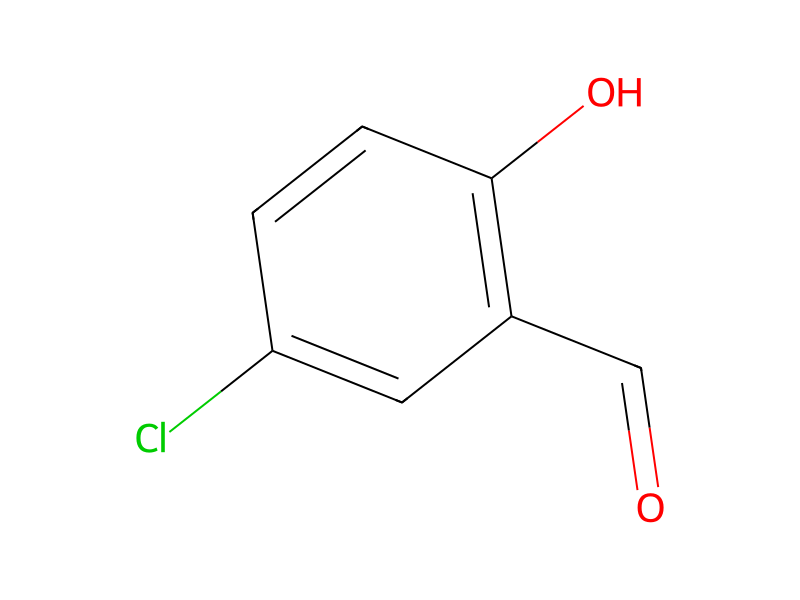
[Cl:1][C:2]1[CH:3]=[CH:4][C:5]([OH:10])=[C:6]([CH:9]=1)[CH:7]=[O:8].Br[CH2:12][CH2:13][CH2:14][OH:15].C([O-])([O-])=O.[K+].[K+]>CN(C=O)C>[Cl:1][C:2]1[CH:3]=[CH:4][C:5]([O:10][CH2:12][CH2:13][CH2:14][OH:15])=[C:6]([CH:9]=1)[CH:7]=[O:8]Participants
5
Reactant 3


Product 1

Reagents, catalysts & solvents 1

Procedure
5-Chloro-2-hydroxy-benzaldehyde (3.1 g, 20 mmol), 3-bromo-propan-1-ol (4.1 mL, 24 mmol), K2CO3 (5.5 g, 4 mmol) and KI (0.5 g) were mixed in DMF (20 mL). Then the mixture was irradiated under microwave at 200° C. for 1 h. The mixture was filtered and the filtrate was concentrated. The residue was dissolved in ethyl acetate and washed with 1N NaOH. Then the organic layer was separated, dried over Na2SO4 and concentrated to give title compound (Yield: 1.7 g, 59%).
Workup
- customThen the mixture was irradiated under microwave at 200° C. for 1 h
- filtrationThe mixture was filtered
- concentrationthe filtrate was concentrated
- dissolutionThe residue was dissolved in ethyl acetate
- washwashed with 1N NaOH
- customThen the organic layer was separated
- dry with materialdried over Na2SO4
- concentrationconcentrated
Sources & evidence
- ORD record
- ord-653dbb65be664e1fbbcc871c9d5ff7d6
- Source dataset
- uspto-grants-2009_02
- Patent number
- US07495007B2
Linked notes
Loading…