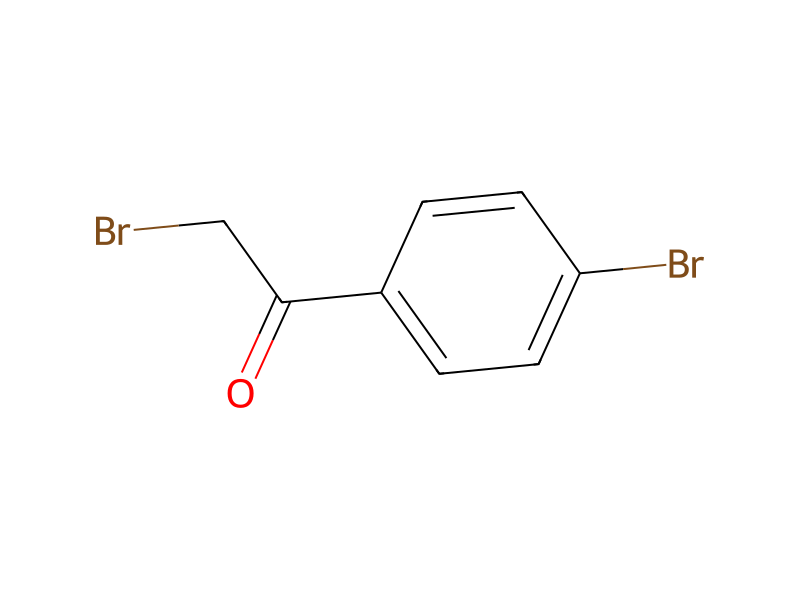
[Br:1][C:2]1[CH:11]=[CH:10][C:5]([C:6](=[O:9])[CH2:7]Br)=[CH:4][CH:3]=1.CN(C)[CH:14]=[O:15].N1(C2[CH2:27][CH2:26][S:25][CH2:24][CH:23]=2)CCCC1>O>[Br:1][C:2]1[CH:11]=[CH:10][C:5]([C:6](=[O:9])[CH2:7][CH:23]2[C:14](=[O:15])[CH2:27][CH2:26][S:25][CH2:24]2)=[CH:4][CH:3]=1A suspension of 41.7 g (0.15 moles) of p-bromophenacyl bromide and 50 ml. of dimethylformamide is added dropwise under nitrogen to a cold stirred solution of 25.4 g (0.15 mole) of 5,6-dihydro-4-(1-pyrrolidinyl)-2H-thiopyran [Example 1 (a)], and 150 ml. of anhydrous dimethylformamide. The reaction mixture is stirred at room temperature for 16 hours, diluted with water, and extracted with chloroform. The chloroform solution is dried over magnesium sulfate and concentrated. The residue is chromatographed on silica gel and eluted with a benzene and chloroform mixture. The solid product is recrystallized from ethanol to provide off-white crystals of 3-(4-bromophenacyl)-2,3,5,6-tetrahydrothiopyran-4-one, m.p. 87.5° to 89.5°C.