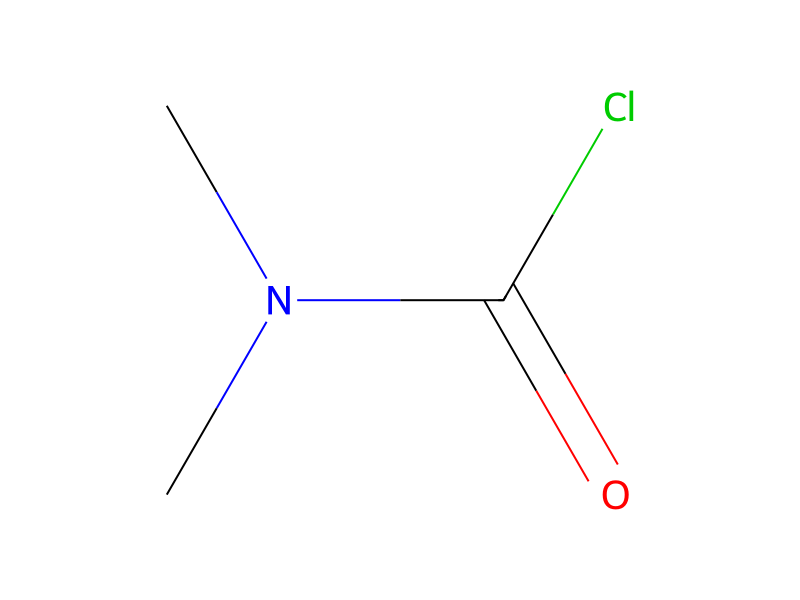
Dimethylcarbamoyl Chloride → HCID 12791206, compound
HRID 1733299
Reaction equation

[CH3:1][N:2]([CH3:15])[CH2:3][CH2:4][NH:5][C:6]1[NH:7][C:8]2[CH:14]=[CH:13][CH:12]=[CH:11][C:9]=2[N:10]=1.C(N(CC)CC)C.[CH3:23][N:24]([CH3:28])[C:25](Cl)=[O:26]>C1C=CC=CC=1>[CH3:23][N:24]([CH3:28])[C:25]([N:5]([CH2:4][CH2:3][N:2]([CH3:15])[CH3:1])[C:6]1[NH:10][C:9]2[CH:11]=[CH:12][CH:13]=[CH:14][C:8]=2[N:7]=1)=[O:26]Participants
5
Reactant 3


Product 1

Reagents, catalysts & solvents 1

Procedure
Following the procedure of Example 1C, using 9.4 g. (0.046 moles) of N,N-dimethyl-N'-(2-benzimidazolyl)-1,2-ethane diamine, 6.0 g. (0.06 moles) of triethylamine, 5.7 g. (0.053 moles) of N,N-dimethylcarbamoyl chloride and 150 ml. of benzene, there is obtained N,N-dimethyl-N'-(2-dimethylaminoethyl)-N'-(2-benzimidazolyl) urea, which, after chromatographic separation on 375 g. of silica gel, and elution with a mixture of 500 ml. of chloroform, 100 ml. of isopropanol, 100 ml. of toluene and 10 ml. of triethylamine, affords 9.4 g. of oil. This is treated with hydrogen bromide and recrystallized from ethanol to give 8.2 g. of dihydrobromide salt, m.p. 193°-195° C.