HomeMCPWorkbenchSkills
HomeWorkbenchNotificationsMe
llms.txt · MCP GuidePrivacy Policy · Terms of Service · Supportv1.8.3
  1. Home
  2. /Reaction

Benzoin → (5R)-5-(4,5-diphenyloxazol-2-yl)pyrrolidin-2-one

HRID 1741365
Print

Reaction equation

HRID 1741365 reaction equation
[NH:1]1[C:5](=[O:6])[CH2:4][CH2:3][C@@H:2]1[C:7]([OH:9])=O.[C:10]1([C:16]([CH:18]([C:20]2[CH:25]=[CH:24][CH:23]=[CH:22][CH:21]=2)O)=O)[CH:15]=[CH:14][CH:13]=[CH:12][CH:11]=1.C([N:28]=C=NCCCN(C)C)C>C(Cl)Cl.CN(C)C1C=CN=CC=1>[C:10]1([C:16]2[N:28]=[C:7]([C@@H:2]3[NH:1][C:5](=[O:6])[CH2:4][CH2:3]3)[O:9][C:18]=2[C:20]2[CH:25]=[CH:24][CH:23]=[CH:22][CH:21]=2)[CH:15]=[CH:14][CH:13]=[CH:12][CH:11]=1
ParticipantsProcedureWorkupSources & evidenceReaction notes

Participants

6

Reactant 3

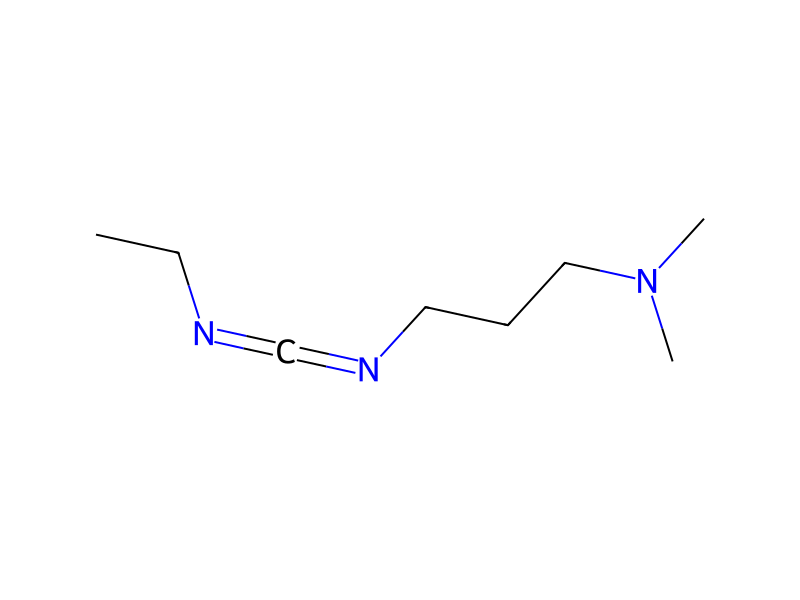
HCID 8400BenzoinHCID 159081-Ethyl-3-(3'-dimethylaminopropyl)carbodiimideHCID 439685D-Pyroglutamic acid

Product 1

HCID 54104002(5R)-5-(4,5-diphenyloxazol-2-yl)pyrrolidin-2-one

Reagents, catalysts & solvents 2

HCID 142844-(Dimethylamino)pyridineCatalyst
HCID 6344
Dichloromethane
Solvent

Procedure

To a solution of D-pyroglutamic acid (30 g) in CH2Cl2 (200 ml) were added benzoin (74 g), 1-ethyl-3-(3-dimethylaminopropyl)carbodiimide (68 ml) and 4-dimethylaminopyridine (30 g) at room temperature under N2. After being stirred for 12 hours at room temperature, the solvent was evaporated in vacuo, and the residue was partitioned between ethyl acetate and water. The organic layer was washed with 1N-HCl solution, sat. NaHCO3 and brine, dried over MgSO4, and evaporated in vacuo. The obtained compound and ammonium acetate (60 g) were dissolved in acetic acid (500 ml) and the mixture was stirred for 4 hours at 100° C. After the solvent was removed, the residue was partitioned between ethyl acetate and water. The organic layer was washed with water, sat. NaHCO3 and brine. The dried solvent was evaporated in vacuo and the residue was purified by chromatography on silica gel to give (5R)-5-(4,5-diphenyloxazol-2-yl)pyrrolidin-2-one (21.2 g). MS (m/z): 305 (M+ +1) IR (Neat): 3200, 1680, 1640 cm-1NMR (CDCl3, δ): 2.3-2.8 (4H, m), 4.8-5.0 (1H, m), 6.24 (1H, br s), 7.2-7.7 (10H, m)

Workup

  1. customthe solvent was evaporated in vacuo
  2. customthe residue was partitioned between ethyl acetate and water
  3. washThe organic layer was washed with 1N-HCl solution, sat. NaHCO3 and brine
  4. dry with materialdried over MgSO4
  5. customevaporated in vacuo
  6. dissolutionThe obtained compound and ammonium acetate (60 g) were dissolved in acetic acid (500 ml)
  7. stirringthe mixture was stirred for 4 hours at 100° C
  8. customAfter the solvent was removed
  9. customthe residue was partitioned between ethyl acetate and water
  10. washThe organic layer was washed with water, sat. NaHCO3 and brine
  11. customThe dried solvent was evaporated in vacuo
  12. customthe residue was purified by chromatography on silica gel

Sources & evidence

ORD record
ord-9583ef8ef96e4c4daa628e330c2d195a
Source dataset
uspto-grants-1999_10
DOI
10.6084/m9.figshare.5104873.v1
Patent number
US05972965

Reaction notes

On this pageParticipantsProcedureWorkupSources & evidenceReaction notes