HomeMCPSkillsWorkbenchOpenChem
HomeWorkbenchNotificationsMe
llms.txt · skill.md · MCP GuidePrivacy Policy · Terms of Service · Supportv1.8.4
  1. Home
  2. /Reaction

Triethylamine → 4-(Morpholin-4-yl)-5-(4,4,5,5-tetramethyl-1,3,2-dioxaborolan-2-yl)-7-{[2-(trimethylsilyl)ethoxy]methyl}-7H-pyrrolo[2,3-d]pyrimidine

HRID 1750253
Print

Reaction equation

I[C:2]1[C:10]2[C:9]([N:11]3[CH2:16][CH2:15][O:14][CH2:13][CH2:12]3)=[N:8][CH:7]=[N:6][C:5]=2[N:4]([CH2:17][O:18][CH2:19][CH2:20][Si:21]([CH3:24])([CH3:23])[CH3:22])[CH:3]=1.[CH3:25][C:26]1([CH3:33])[C:30]([CH3:32])([CH3:31])[O:29][BH:28][O:27]1.C(N(CC)CC)C.C1(P(C2CCCCC2)C2C=CC=CC=2C2C(C(C)C)=CC(C(C)C)=CC=2C(C)C)CCCCC1>O1CCOCC1.O.C1C=CC(/C=C/C(/C=C/C2C=CC=CC=2)=O)=CC=1.C1C=CC(/C=C/C(/C=C/C2C=CC=CC=2)=O)=CC=1.C1C=CC(/C=C/C(/C=C/C2C=CC=CC=2)=O)=CC=1.[Pd].[Pd]>[N:11]1([C:9]2[C:10]3[C:2]([B:28]4[O:29][C:30]([CH3:32])([CH3:31])[C:26]([CH3:33])([CH3:25])[O:27]4)=[CH:3][N:4]([CH2:17][O:18][CH2:19][CH2:20][Si:21]([CH3:24])([CH3:23])[CH3:22])[C:5]=3[N:6]=[CH:7][N:8]=2)[CH2:16][CH2:15][O:14][CH2:13][CH2:12]1

ParticipantsConditionsProcedureWorkupSources & evidenceReaction notes

Participants

8

Reactant 4

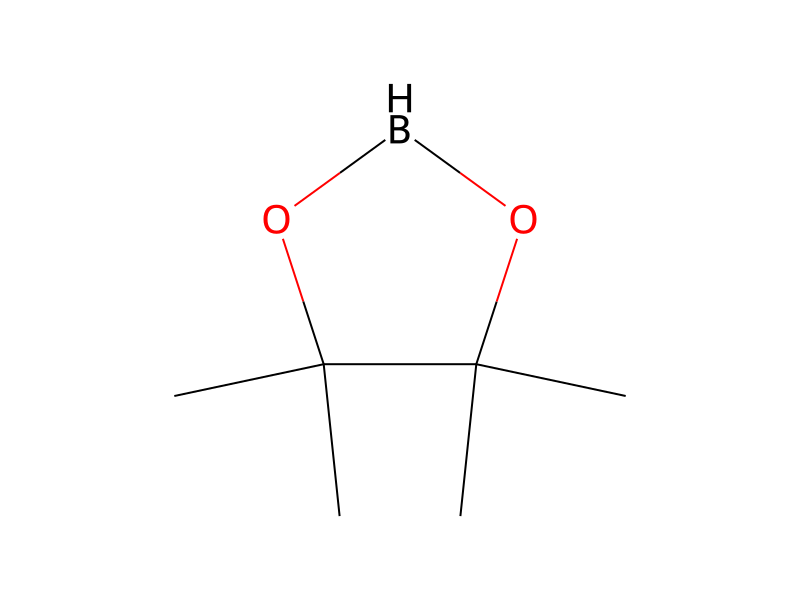
HCID 8471TriethylamineHCID 27347684,4,5,5-Tetramethyl[1,3,2]dioxaborolaneHCID 111557942-Dicyclohexylphosphino-2',4',6'-triisoprophylbiphenylHCID 867069325-iodo-4-(morpholin-4-yl)-7-{[2-(trimethylsilyl)ethoxy]methyl}-7H-pyrrolo[2,3-d]pyrimidine

Product 1

HCID 86706934
4-(Morpholin-4-yl)-5-(4,4,5,5-tetramethyl-1,3,2-dioxaborolan-2-yl)-7-{[2-(trimethylsilyl)ethoxy]methyl}-7H-pyrrolo[2,3-d]pyrimidine

Reagents, catalysts & solvents 3

HCID 9811564Bis(dibenzylideneacetone)palladiumCatalystHCID 962WaterSolventHCID 312751,4-DioxaneSolvent

Conditions

Temperature
95 °C

Procedure

To a solution of 5-iodo-4-(morpholin-4-yl)-7-{[2-(trimethylsilyl)ethoxy]methyl}-7H-pyrrolo[2,3-d]pyrimidine (P1) (500 mg, 1.09 mmol) and 4,4,5,5-tetramethyl-1,3,2-dioxaborolane (543 mg, 4.24 mmol) in 1,4-dioxane (20 mL) was added tris(dibenzylideneacetone)dipalladium(0) (99.7 mg, 0.109 mmol), triethylamine (439 mg, 4.34 mmol) and 2-dicyclohexylphosphino-2′,4′,6′-triisopropylbiphenyl (XPhos, 51.8 mg, 0.109 mmol), and the reaction mixture was heated at 95° C. for 18 hours. After cooling to room temperature, the reaction mixture was diluted with water (100 mL) and extracted with ethyl acetate (3×50 mL). The combined organic layers were washed with saturated aqueous sodium chloride solution (100 mL), dried over sodium sulfate, filtered, and concentrated in vacuo. Purification via silica gel chromatography (Gradient: 0% to 30% ethyl acetate in petroleum ether) afforded the product as a yellow oil. Yield: 415 mg, 0.901 mmol, 83%. LCMS m/z 461.3 [M+H+]. 1H NMR (400 MHz, CDCl3) δ 8.45 (s, 1H), 7.73 (s, 1H), 5.59 (s, 2H), 3.87-3.93 (m, 4H), 3.68-3.74 (m, 4H), 3.49-3.56 (m, 2H), 1.35 (s, 12H), 0.87-0.93 (m, 2H), −0.06 (s, 9H).

Workup

  1. temperatureAfter cooling to room temperature
  2. extractionextracted with ethyl acetate (3×50 mL)
  3. washThe combined organic layers were washed with saturated aqueous sodium chloride solution (100 mL)
  4. dry with materialdried over sodium sulfate
  5. filtrationfiltered
  6. concentrationconcentrated in vacuo
  7. customPurification via silica gel chromatography (Gradient: 0% to 30% ethyl acetate in petroleum ether)

Sources & evidence

ORD record
ord-dace7c5e7e1a4b7ba5a7d9fd3a531f3d
Source dataset
uspto-grants-2015_10
DOI
10.6084/m9.figshare.5104873.v1
Patent number
US09156845B2

Reaction notes

On this pageParticipantsConditionsProcedureWorkupSources & evidenceReaction notes


