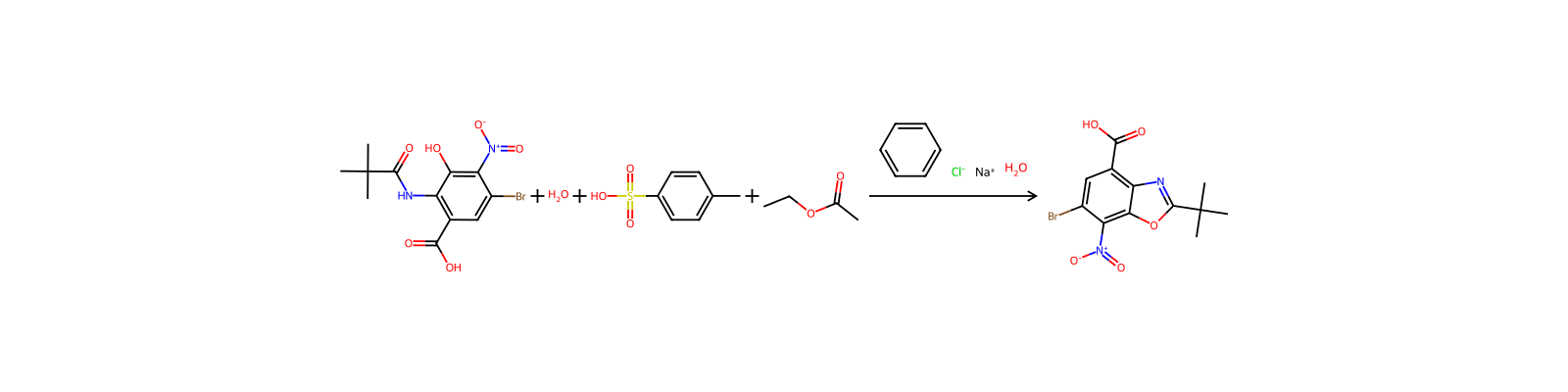
[Br:1][C:2]1[C:3]([N+:19]([O-:21])=[O:20])=[C:4]([OH:18])[C:5]([NH:11][C:12](=O)[C:13]([CH3:16])([CH3:15])[CH3:14])=[C:6]([CH:10]=1)[C:7]([OH:9])=[O:8].O.C1(C)C=CC(S(O)(=O)=O)=CC=1.C(OCC)(=O)C>C1C=CC=CC=1.[Cl-].[Na+].O>[Br:1][C:2]1[C:3]([N+:19]([O-:21])=[O:20])=[C:4]2[O:18][C:12]([C:13]([CH3:16])([CH3:15])[CH3:14])=[N:11][C:5]2=[C:6]([C:7]([OH:9])=[O:8])[CH:10]=15-Bromo-2-(2,2-dimethylpropionylamino)-3-hydroxy-4-nitrobenzoic acid (I-221) (1.90 g, 5.26 mmol) was dissolved in benzene (38 ml), then p-toluenesulfonic acid monohydrate (1.00 g, 5.26 mmol) was added at room temperature. Under nitrogen atmosphere, the reaction liquid was heated under reflux for 21 hours, then cooled to room temperature. The reaction liquid was fractionated with ethyl acetate and saturated brine. The organic layer was washed with saturated brine, and dried over anhydrous sodium sulfate. The insoluble matter was removed by filtration, the solvent was evaporated away and the resulting residue was purified by middle-pressure liquid chromatography (eluent, ethyl acetate:methanol=4:1) to obtain the entitled compound (1.80 g, 98%) as a brown solid.