HomeMCPWorkbenchSkills
HomeWorkbenchNotificationsMe
llms.txt · MCP GuidePrivacy Policy · Terms of Service · Supportv1.8.1
  1. Home
  2. /Reaction

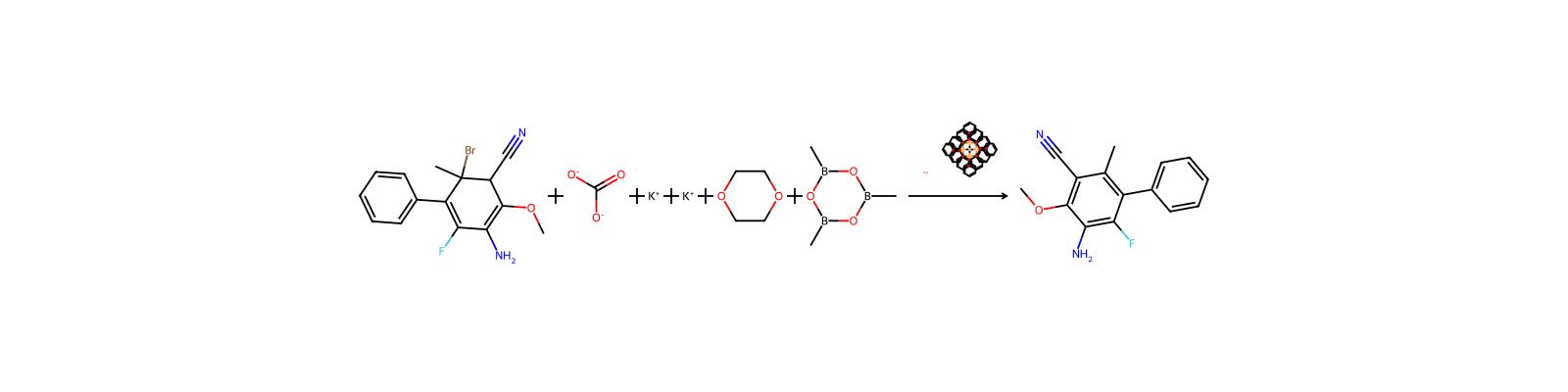
Potassium Carbonate → 5-Amino-6-fluoro-4-methoxy-2-methylbiphenyl-3-carbonitrile

HRID 17525
Print

Reaction equation

HRID 17525 reaction equation
[NH2:1][C:2]1[C:7]([F:8])=[C:6]([C:9]2[CH:14]=[CH:13][CH:12]=[CH:11][CH:10]=2)[C:5](Br)([CH3:15])[CH:4]([C:17]#[N:18])[C:3]=1[O:19][CH3:20].C(=O)([O-])[O-].[K+].[K+].O1CCOCC1.CB1OB(C)OB(C)O1>O.C1C=CC([P]([Pd]([P](C2C=CC=CC=2)(C2C=CC=CC=2)C2C=CC=CC=2)([P](C2C=CC=CC=2)(C2C=CC=CC=2)C2C=CC=CC=2)[P](C2C=CC=CC=2)(C2C=CC=CC=2)C2C=CC=CC=2)(C2C=CC=CC=2)C2C=CC=CC=2)=CC=1>[NH2:1][C:2]1[C:3]([O:19][CH3:20])=[C:4]([C:17]#[N:18])[C:5]([CH3:15])=[C:6]([C:9]2[CH:14]=[CH:13][CH:12]=[CH:11][CH:10]=2)[C:7]=1[F:8]
ParticipantsConditionsProcedureWorkupSources & evidenceReaction notes

Participants

7

Reactant 4

HCID 11430Potassium CarbonateHCID 312751,4-DioxaneHCID 574072TrimethylboroxineHCID 685848335-Amino-2-bromo-6-fluoro-4-methoxy-2-methylbiphenyl-3-carbonitrile

Product 1

HCID 860975095-Amino-6-fluoro-4-methoxy-2-methylbiphenyl-3-carbonitrile

Reagents, catalysts & solvents 2

HCID 178418397
HCID 178418397, compound
Catalyst
2×
HCID 962WaterSolvent

Conditions

Temperature
110 °C

Procedure

5-Amino-2-bromo-6-fluoro-4-methoxy-2-methylbiphenyl-3-carbonitrile (I-235) (2.02 g, 6.29 mmol), potassium carbonate (2.61 g, 18.87 mmol) and tetrakis(triphenylphosphine)palladium(0) (727 mg, 0.63 mmol) were dissolved in 10% water-containing 1,4-dioxane (50 ml), and at room temperature, trimethylboroxine (50 wt. % tetrahydrofuran solution, 1.90 ml, 7.55 mmol) was added. After stirring under nitrogen atmosphere at 110° C. for 8 hours and then cooling to room temperature, tetrakis(triphenylphosphine)palladium(0) (727 mg, 0.63 mmol) was added, followed by further stirring at 110° C. for 11 hours. After cooling to room temperature, the insoluble matter was separated by filtration, the filtrate was fractionated with ethyl acetate and saturated brine. The organic layer was separated, the aqueous layer was again extracted with ethyl acetate.

Workup

  1. temperaturecooling to room temperature
  2. stirringby further stirring at 110° C. for 11 hours
  3. temperatureAfter cooling to room temperature
  4. customthe insoluble matter was separated by filtration
  5. customThe organic layer was separated
  6. extractionthe aqueous layer was again extracted with ethyl acetate

Sources & evidence

ORD record
ord-41d3ba0b6a6148fcbd9992559d038a83
Source dataset
uspto-grants-2010_06
DOI
10.6084/m9.figshare.5104873.v1
Patent number
US07737166B2

Reaction notes

On this pageParticipantsConditionsProcedureWorkupSources & evidenceReaction notes