Triethylamine → (R)-1-[2-(2, 3-methylenedioxyphenyl) heptyl]-3-(4-ethoxycarbonyl-1-phenylpyrazole-5-yl) urea
HRID 1756790
Reaction equation
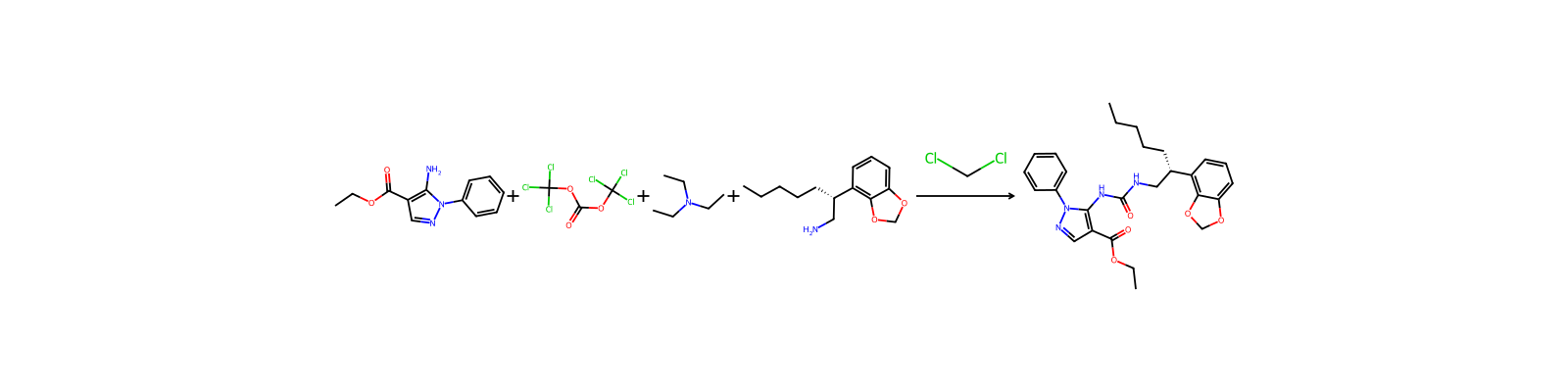
[CH2:1]([O:3][C:4]([C:6]1[CH:7]=[N:8][N:9]([C:12]2[CH:17]=[CH:16][CH:15]=[CH:14][CH:13]=2)[C:10]=1[NH2:11])=[O:5])[CH3:2].[C:18](=O)(OC(Cl)(Cl)Cl)[O:19]C(Cl)(Cl)Cl.C(N(CC)CC)C.[CH2:37]1[O:45][C:44]2[C:39](=[C:40]([C@@H:46]([CH2:49][CH2:50][CH2:51][CH2:52][CH3:53])[CH2:47][NH2:48])[CH:41]=[CH:42][CH:43]=2)[O:38]1>C(Cl)Cl>[CH2:37]1[O:45][C:44]2[C:39](=[C:40]([C@@H:46]([CH2:49][CH2:50][CH2:51][CH2:52][CH3:53])[CH2:47][NH:48][C:18]([NH:11][C:10]3[N:9]([C:12]4[CH:17]=[CH:16][CH:15]=[CH:14][CH:13]=4)[N:8]=[CH:7][C:6]=3[C:4]([O:3][CH2:1][CH3:2])=[O:5])=[O:19])[CH:41]=[CH:42][CH:43]=2)[O:38]1Participants
6





