Reaction equation
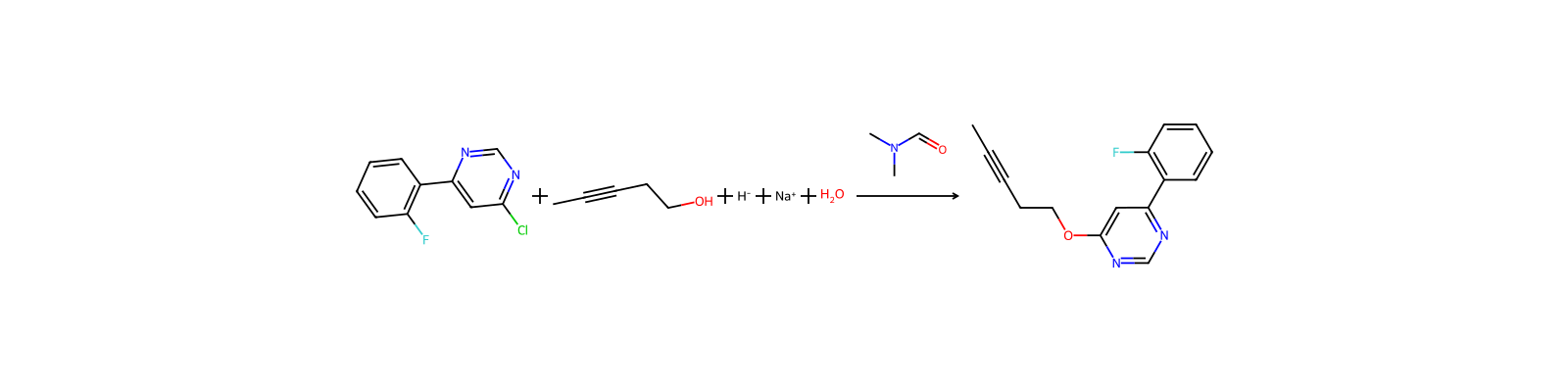
Cl[C:2]1[CH:7]=[C:6]([C:8]2[CH:13]=[CH:12][CH:11]=[CH:10][C:9]=2[F:14])[N:5]=[CH:4][N:3]=1.[CH2:15]([OH:20])[CH2:16][C:17]#[C:18][CH3:19].[H-].[Na+].O>CN(C)C=O>[F:14][C:9]1[CH:10]=[CH:11][CH:12]=[CH:13][C:8]=1[C:6]1[CH:7]=[C:2]([O:20][CH2:15][CH2:16][C:17]#[C:18][CH3:19])[N:3]=[CH:4][N:5]=1Participants
6





Procedure
In 10 ml of N,N-dimethylformamide were dissolved 457 mg of 4-chloro-6-(2-fluorophenyl)pyrimidine and 277 mg of 3-pentyn-1-ol, to which 132 mg of sodium hydride (60% in oil) was added, followed by stirring at room temperature for 8 hours. The reaction mixture was then poured into water and extracted three times with ethyl acetate. The organic layers were combined, washed with a saturated aqueous sodium chloride solution, dried over anhydrous magnesium sulfate, and then concentrated. The resulting residue was subjected to silica gel column chromatography to give 467 mg of 4-(2-fluorophenyl)-6-(3-pentynyloxy)pyrimidine (the present compound (153)).
Workup
- extractionextracted three times with ethyl acetate
- washwashed with a saturated aqueous sodium chloride solution
- dry with materialdried over anhydrous magnesium sulfate
- concentrationconcentrated
Sources & evidence
- ORD record
- ord-355e80af1d724861ad014a9594455531
- Source dataset
- uspto-grants-2005_01
- Patent number
- US06838463B2
Linked notes
Loading…