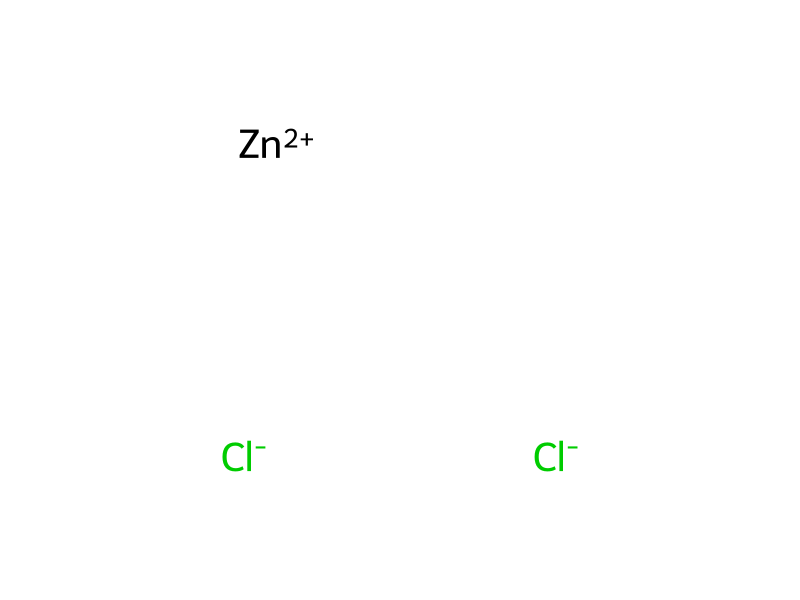
CCOCC.Cl[C:7]1[N:12]=[C:11]([Cl:13])[C:10]([C:14]([F:17])([F:16])[F:15])=[CH:9][N:8]=1.[NH2:18][C:19]1[CH:33]=[CH:32][C:22]([CH2:23][NH:24][C:25](=[O:31])[O:26][C:27]([CH3:30])([CH3:29])[CH3:28])=[CH:21][CH:20]=1.CCN(CC)CC>[Cl-].[Cl-].[Zn+2].ClCCCl.CC(O)(C)C>[Cl:13][C:11]1[C:10]([C:14]([F:17])([F:16])[F:15])=[CH:9][N:8]=[C:7]([NH:18][C:19]2[CH:33]=[CH:32][C:22]([CH2:23][NH:24][C:25](=[O:31])[O:26][C:27]([CH3:29])([CH3:30])[CH3:28])=[CH:21][CH:20]=2)[N:12]=1A 1.0 M ZnCl2 solution in Et2O (5.40 mL, 5.40 mmol) was added cautiously to a stirred suspension of 2,4-dichloro-5-(trifluoromethyl)pyrimidine (1.03 g, 4.72 mmol) in 1:1 t-BuOH:DCE (200 mL) at room temperature. After stirring for 20 minutes, tert-butyl 4-aminobenzylcarbamate (A11) (1.00 g, 4.50 mmol) was added followed by Et3N (752 μL, 5.40 mmol) and the resulting mixture stirred at room temperature overnight. The volatiles were removed in vacuo and the resulting tan solid was suspended in water (500 mL). The suspension was sonicated for 10 minutes, filtered and the filter cake was washed with water (2×100 mL) then dried under high vacuum to give the title compound A12 as a tan solid (1.77 g, 97%); 1H NMR (400 MHz, d6-DMSO) δ 10.63 (s, 1H), 8.79 (s, 1H), 7.61 (d, J=8.1 Hz, 2H), 7.36 (t, J=7.6 Hz, 1H), 7.22 (d, J=8.4 Hz, 2H), 4.10 (d, J=6.0 Hz, 2H), 1.40 (s, 9H). LCMS-A: rt 6.356 min; m/z 401 [M−1]−.