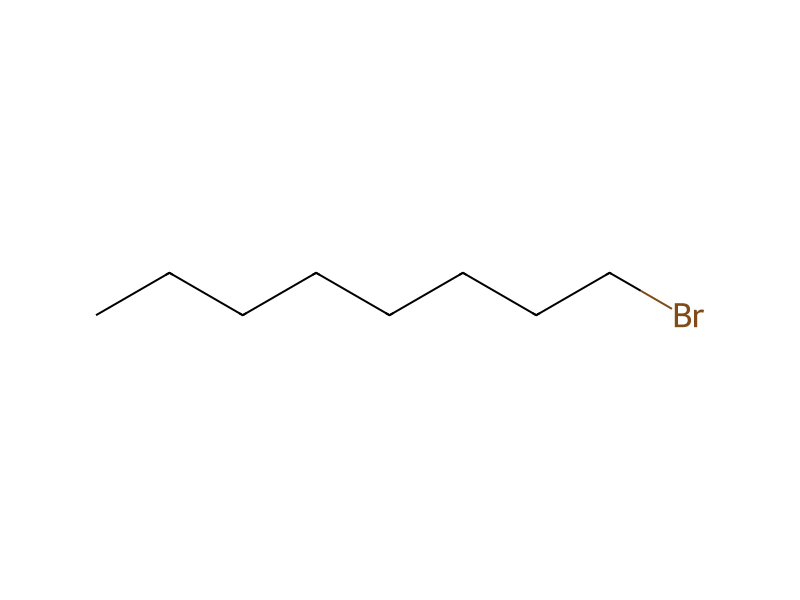
C(NC(C)C)(C)C.C([Li])CCC.[F:13][C:14]1[CH:19]=[CH:18][CH:17]=[C:16]([C:20]2[CH:25]=[CH:24][C:23]([O:26][CH2:27][CH2:28][CH2:29][CH2:30][CH2:31][CH2:32][CH2:33][CH3:34])=[CH:22][CH:21]=2)[N:15]=1.Br[CH2:36][CH2:37][CH2:38][CH2:39][CH2:40][CH2:41][CH2:42][CH3:43]>O1CCCC1.CCCCCC.O>[F:13][C:14]1[C:19]([CH2:36][CH2:37][CH2:38][CH2:39][CH2:40][CH2:41][CH2:42][CH3:43])=[CH:18][CH:17]=[C:16]([C:20]2[CH:25]=[CH:24][C:23]([O:26][CH2:27][CH2:28][CH2:29][CH2:30][CH2:31][CH2:32][CH2:33][CH3:34])=[CH:22][CH:21]=2)[N:15]=10.74 g (7.3 mmol) of diisopropylamine in 30 ml of tetrahydrofuran is stirred at 0° C. with 4.56 ml (7.3 mmol) of a 1.6-molar n-butyllithium solution in hexane under argon for 1 hour. After cooling to -78° C., 2.00 g (6.64 mmol) of 2-fluoro-6-(4-octyloxyphenyl)pyridine in 30 ml of tetrahydrofuran are added dropwise at such a rate that the temperature does not exceed 70° C. After 4 hours at -78° C., 1.35 g (7.00 mmol) of 1-bromooctane in 10 ml of tetrahydrofuran are added dropwise while also maintaining a temperature ≤-70° C. The reaction mixture is stirred overnight, during which it warms to room temperature, 5 ml of water are added, and the mixture is evaporated to dryness. The residue is taken up in ether, the resulting solution is washed twice with water, the organic phase is dried over sodium sulfate, filtered, the solvent is distilled off, the residue is purified by chromatography (silica gel, 9:1 hexane/ethyl acetate) and recrystallized from acetonitrile, giving 0.10 g of 2-fluoro-3-octyl-6-(4-octyloxyphenyl)pyridine, whose physical properties are identical to those of the product prepared by Example 1.
Loading…