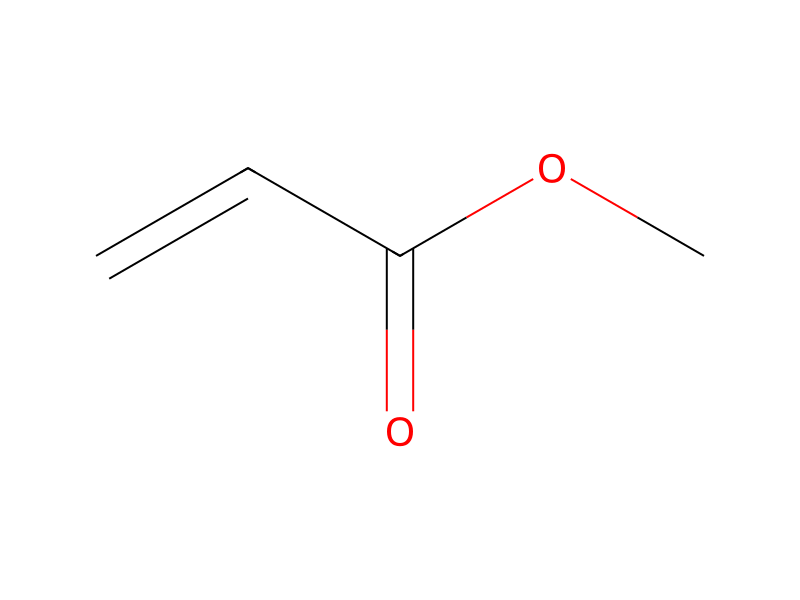
Methyl Acrylate → Methyl 3-(diphenylphosphino)propanoate
Reaction equation

[C:1]([O:5][CH3:6])(=[O:4])[CH:2]=[CH2:3].[C:7]1([PH:13][C:14]2[CH:19]=[CH:18][CH:17]=[CH:16][CH:15]=2)[CH:12]=[CH:11][CH:10]=[CH:9][CH:8]=1.C([O-])(=O)C=C>>[C:1]([CH2:2][CH2:3][P:13]([C:14]1[CH:15]=[CH:16][CH:17]=[CH:18][CH:19]=1)[C:7]1[CH:12]=[CH:11][CH:10]=[CH:9][CH:8]=1)([O:5][CH3:6])=[O:4]Participants
4


Procedure
A mixture of 8.6 g (0.1 mole) and methyl acrylate and 19.5 g (0.105 mole, 5% excess) of diphenyl phosphine was reacted at 15° C. in the routine manner of Example 1. U.V. irradiation resulted in a rapid reaction. After 1 hour, there was no acrylate left unconverted. The expected mono- and diadducts were formed in a weight ration of about 95 to 5. (A sample of the reaction misture which was not irradiated also showed a complete conversion after 22 hours but not after 1 hour). On distillation of the reaction mixture in vacuo, the monoadduct, i.e. 2-carbomethoxyethyl diphenyl phosphine, was obtained as an almost colorless, liquid distillate having a slight yellow tint (Table 3).
Workup
- customwas reacted at 15° C. in the routine manner of Example 1
- customirradiation
- customresulted in a rapid reaction
- waitleft unconverted
- customThe expected mono- and diadducts were formed in a weight ration of about 95 to 5
- custom(A sample of the reaction misture which was not irradiated also
- customafter 22 hours
- waitnot after 1 hour)
- distillationOn distillation of the reaction mixture in vacuo
Sources & evidence
- ORD record
- ord-9d10bc24ee80433b8fb0af20718b63f2
- Source dataset
- uspto-grants-1987_08
- Patent number
- US04687874
Reaction notes
Loading…