Reaction equation

[Br:1][C:2]1[NH:10][C:9]2[C:8](=[O:11])[NH:7][C:6](=[O:12])[N:5]([CH3:13])[C:4]=2[N:3]=1.[C:14](=O)([O-])[O-].[K+].[K+].CI>CN(C)C=O>[Br:1][C:2]1[N:10]([CH3:14])[C:9]2[C:8](=[O:11])[NH:7][C:6](=[O:12])[N:5]([CH3:13])[C:4]=2[N:3]=1Participants
5




Procedure
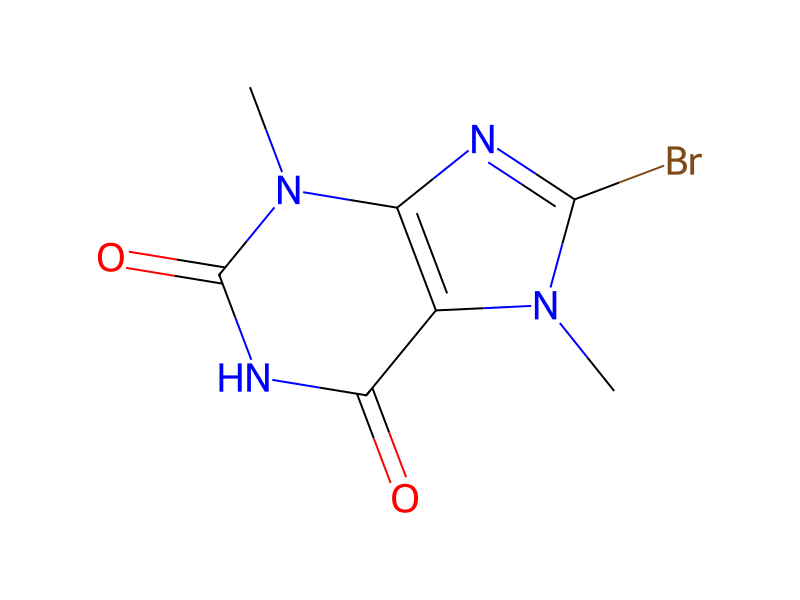
To a stirring suspension of 8-bromo-3-methylxanthine (prepared as described above for CT12440) (12.25 g, 50.0 mmol) and potassium carbonate (8.62 g, 62.5 mmol) in dimethylformamide (150 ml) was added methyl iodide (7.81 g, 55.0 mmol). After stirring overnight at room temperature, the mixture was poured into ice cold water (400 ml) and stirred at 0-5° C. for 1 hour. The precipitate was filtered, rinsed with water (5x 25 ml) and dried under vacuum to provide 8-bromo-3,7-dimethylxanthine (12.10 g, 93% yield) as a beige solid.
Workup
- stirringstirred at 0-5° C. for 1 hour
- filtrationThe precipitate was filtered
- washrinsed with water (5x 25 ml)
- customdried under vacuum
Sources & evidence
- ORD record
- ord-9655b689d12b473bb284ec4c9816e161
- Source dataset
- uspto-grants-2005_04
- Patent number
- US06878715B1
Linked notes
Loading…