HomeMCPWorkbenchSkills
HomeWorkbenchNotificationsMe
llms.txt · MCP GuidePrivacy Policy · Terms of Service · Supportv1.8.0
  1. Home
  2. /Reaction

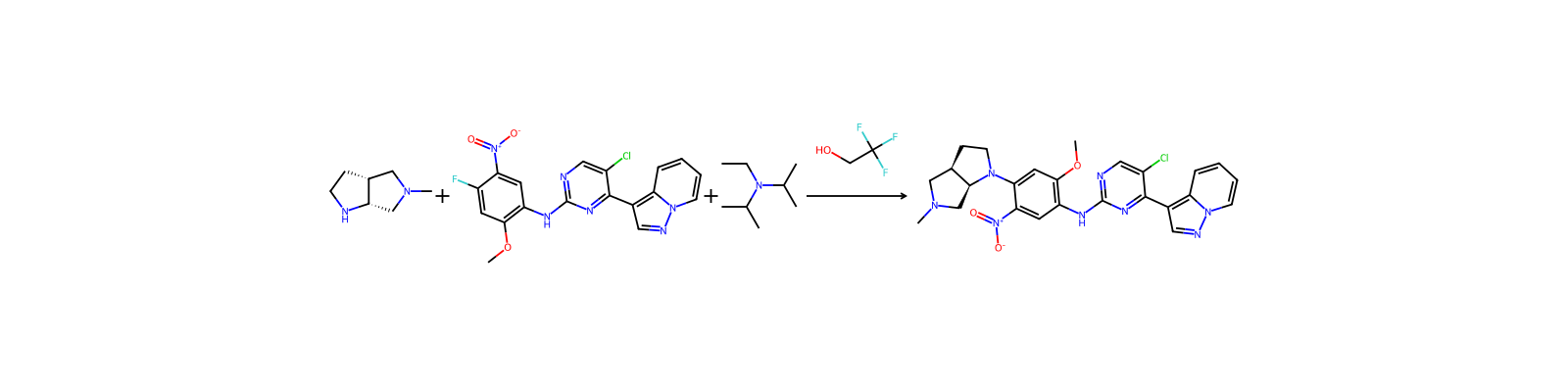
Diisopropylethylamine → N-[4-[(3aR,6aR)-5-methyl-2,3,3a,4,6,6a-hexahydropyrrolo[3,2-c]pyrrol-1-yl]-2-methoxy-5-nitrophenyl]-5-chloro-4-pyrazolo[1,5-a]pyridin-3-ylpyrimidin-2-amine

HRID 1842699
Notes
Print preview

Reaction equation

HRID 1842699 reaction equation
[CH3:1][N:2]1[CH2:6][C@@H:5]2[NH:7][CH2:8][CH2:9][C@@H:4]2[CH2:3]1.[Cl:10][C:11]1[C:12]([C:30]2[CH:31]=[N:32][N:33]3[CH:38]=[CH:37][CH:36]=[CH:35][C:34]=23)=[N:13][C:14]([NH:17][C:18]2[CH:23]=[C:22]([N+:24]([O-:26])=[O:25])[C:21](F)=[CH:20][C:19]=2[O:28][CH3:29])=[N:15][CH:16]=1.CCN(C(C)C)C(C)C>FC(F)(F)CO>[CH3:1][N:2]1[CH2:6][C@@H:5]2[N:7]([C:21]3[C:22]([N+:24]([O-:26])=[O:25])=[CH:23][C:18]([NH:17][C:14]4[N:13]=[C:12]([C:30]5[CH:31]=[N:32][N:33]6[CH:38]=[CH:37][CH:36]=[CH:35][C:34]=56)[C:11]([Cl:10])=[CH:16][N:15]=4)=[C:19]([O:28][CH3:29])[CH:20]=3)[CH2:8][CH2:9][C@@H:4]2[CH2:3]1
ParticipantsConditionsProcedureWorkupSources & evidenceReaction notes

Participants

5

Reactant 3

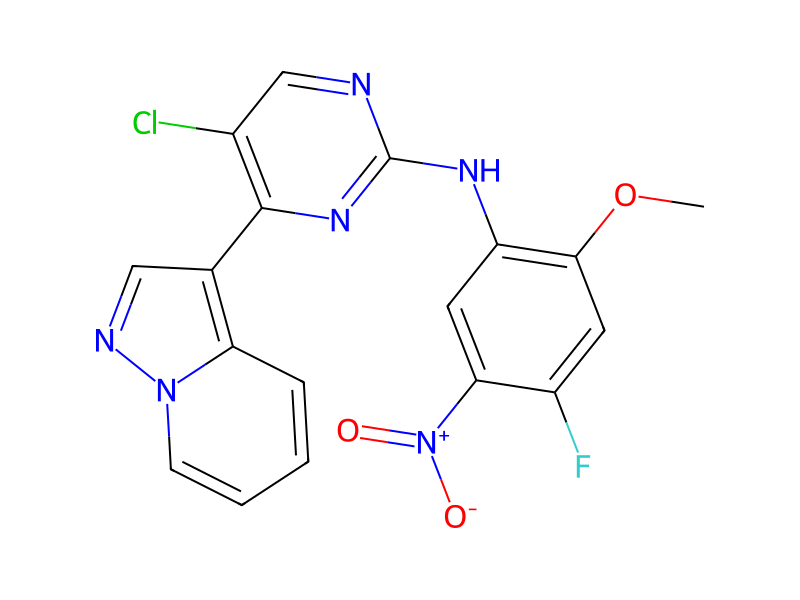
HCID 81531DiisopropylethylamineHCID 44221716(3aR,6aR)-5-Methyloctahydropyrrolo[3,4-b]pyrrole2×HCID 712393485-chloro-N-(4-fluoro-2-methoxy-5-nitrophenyl)-4-pyrazolo[1,5-a]pyridin-3-ylpyrimidin-2-amine2×

Product 1

HCID 71270223N-[4-[(3aR,6aR)-5-methyl-2,3,3a,4,6,6a-hexahydropyrrolo[3,2-c]pyrrol-1-yl]-2-methoxy-5-nitrophenyl]-5-chloro-4-pyrazolo[1,5-a]pyridin-3-ylpyrimidin-2-amine
Yield 49.6%

Reagents, catalysts & solvents 1

HCID 64092,2,2-TrifluoroethanolSolvent

Conditions

Temperature
140 °C

Procedure

(3aR,6aR)-5-Methyl-2,3,3a,4,6,6a-hexahydro-1H-pyrrolo[3,2-c]pyrrole (Intermediate 37, 91 mg, 0.72 mmol) was added to a mixture of 5-chloro-N-(4-fluoro-2-methoxy-5-nitrophenyl)-4-pyrazolo[1,5-a]pyridin-3-ylpyrimidin-2-amine (Intermediate 20, 250 mg, 0.60 mmol) and DIPEA (0.334 mL, 1.93 mmol) in 2,2,2-trifluoroethanol (3 mL) and the mixture was heated at 140° C. in a microwave for 0.5 h. The mixture was then absorbed onto silica. Purification by FCC, eluting with 2% 7N methnaolic ammonia in CH2Cl2 gave material that was concentrated in vacuo and dissolved in CH3OH. The resulting solution was absorbed onto an SCX column and the column was washed with CH3OH then eluted with 7N methanolic ammonia. Appropriate fractions were concentrated in vacuo to give the title compound (155 mg, 49%) as a orange/red gummy solid; 1H NMR: (CDCl3) 1.89 (1H, dd), 2.04-2.19 (1H, m), 2.24 (3H, s), 2.30-2.39 (1H, m), 2.40-2.57 (2H, m), 2.68 (1H, t), 2.98-3.11 (1H, m), 3.23 (1H, t), 3.51-3.63 (1H, m), 3.97 (3H, s), 4.36-4.48 (1H, m), 6.46 (1H, s), 6.90-7.02 (1H, m), 7.31-7.43 (2H, m), 8.38 (1H, s), 8.48 (1H, dd), 8.53-8.57 (1H, m), 8.82 (1H, s), 8.93 (1H, s); m/z: ES+ MH+ 521.45.

Workup

  1. customThe mixture was then absorbed onto silica
  2. customPurification by FCC
  3. washeluting with 2% 7N methnaolic ammonia in CH2Cl2
  4. customgave material that
  5. concentrationwas concentrated in vacuo
  6. dissolutiondissolved in CH3OH
  7. customThe resulting solution was absorbed onto an SCX column
  8. washthe column was washed with CH3OH
  9. washthen eluted with 7N methanolic ammonia
  10. concentrationAppropriate fractions were concentrated in vacuo

Sources & evidence

ORD record
ord-f597bcdf3a204923bd9e9ed39b5a8790
Source dataset
uspto-grants-2015_02
DOI
10.6084/m9.figshare.5104873.v1
Patent number
US08946235B2

Reaction notes

Loading…

On this pageParticipantsConditionsProcedureWorkupSources & evidenceReaction notes