HomeMCPSkillsWorkbenchOpenChem
HomeWorkbenchNotificationsMe
llms.txt · skill.md · MCP GuidePrivacy Policy · Terms of Service · Supportv1.8.5
  1. Home
  2. /Reaction

Triisopropyl borate → B-(2-Fluoro-4-phenoxyphenyl)boronic acid

HRID 1843331
Print

Reaction equation

Br[C:2]1[CH:7]=[CH:6][C:5]([O:8][C:9]2[CH:14]=[CH:13][CH:12]=[CH:11][CH:10]=2)=[CH:4][C:3]=1[F:15].[Li]CCCC.CC([O:24][B:25](OC(C)C)[O:26]C(C)C)C>O1CCCC1>[F:15][C:3]1[CH:4]=[C:5]([O:8][C:9]2[CH:14]=[CH:13][CH:12]=[CH:11][CH:10]=2)[CH:6]=[CH:7][C:2]=1[B:25]([OH:26])[OH:24]
ParticipantsConditionsProcedureWorkupSources & evidenceReaction notes

Participants

5

Reactant 3

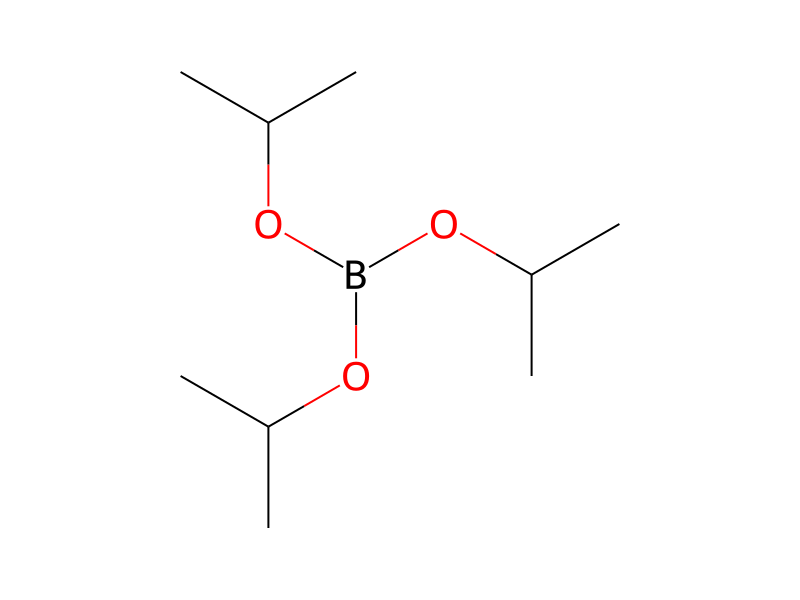
HCID 21531Triisopropyl borateHCID 700859741-Bromo-2-fluoro-4-phenoxybenzeneHCID 178418339Butyllithium

Product 1

HCID 71014093B-(2-Fluoro-4-phenoxyphenyl)boronic acidYield 92.1%

Reagents, catalysts & solvents 1

HCID 8028TetrahydrofuranSolvent

Conditions

Temperature
-75 °C

Procedure

Into a 100 mL 3-necked round-bottom flask purged and maintained under an inert atmosphere of nitrogen, was placed a solution of 1-bromo-2-fluoro-4-phenoxybenzene (2 g, 7.49 mmol, 1.00 equiv) in tetrahydrofuran (20 mL). BuLi (1M) (8 mL) was added dropwise with stirring at −70 to −80° C. The resulting solution was stirred for 30 min at −70-80° C. in a liquid nitrogen bath. Tris(propan-2-yl)borate (1.7 g, 9.04 mmol, 1.21 equiv) was added dropwise with stirring at −70 to −80° C. The resulting solution was allowed to react, with stirring, for an additional 2 h while the temperature was maintained at −70 to −80° C. The reaction was then quenched by the addition of 100 mL of water, extracted with ethyl acetate and the organic layers were combined and dried over anhydrous sodium sulfate and concentrated under vacuum. The residue was loaded onto a silica gel column and eluted with ethyl acetate/petroleum ether (1:20) to give 1.6 g (92%) of (2-fluoro-4-phenoxyphenyl)-boronic acid as a white solid.

Workup

  1. customInto a 100 mL 3-necked round-bottom flask purged
  2. temperaturemaintained under an inert atmosphere of nitrogen
  3. stirringThe resulting solution was stirred for 30 min at −70-80° C. in a liquid nitrogen bath
  4. stirringwith stirring at −70 to −80° C
  5. customto react
  6. stirringwith stirring, for an additional 2 h while the temperature
  7. temperaturewas maintained at −70 to −80° C
  8. customThe reaction was then quenched by the addition of 100 mL of water
  9. extractionextracted with ethyl acetate
  10. dry with materialdried over anhydrous sodium sulfate
  11. concentrationconcentrated under vacuum
  12. washeluted with ethyl acetate/petroleum ether (1:20)

Sources & evidence

ORD record
ord-2d35bd706679479ea3a222aac51f5de5
Source dataset
uspto-grants-2015_02
DOI
10.6084/m9.figshare.5104873.v1
Patent number
US08946241B2

Reaction notes

On this pageParticipantsConditionsProcedureWorkupSources & evidenceReaction notes

