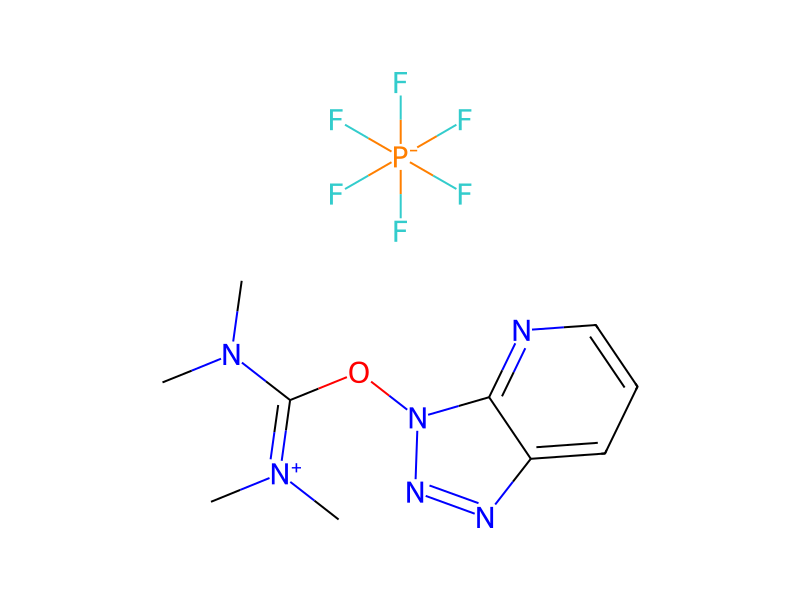
[NH2:1][C:2]1[S:3][C:4]2[CH:10]=[C:9]([O:11][S:12]([C:15]3[CH:20]=[CH:19][C:18]([F:21])=[CH:17][CH:16]=3)(=[O:14])=[O:13])[CH:8]=[CH:7][C:5]=2[N:6]=1.[C:22](O)(=[O:26])[CH2:23][CH2:24][CH3:25].CN(C(ON1N=NC2C=CC=NC1=2)=[N+](C)C)C.F[P-](F)(F)(F)(F)F.C(N(CC)C(C)C)(C)C>CN(C)C=O>[C:22]([NH:1][C:2]1[S:3][C:4]2[CH:10]=[C:9]([O:11][S:12]([C:15]3[CH:20]=[CH:19][C:18]([F:21])=[CH:17][CH:16]=3)(=[O:13])=[O:14])[CH:8]=[CH:7][C:5]=2[N:6]=1)(=[O:26])[CH2:23][CH2:24][CH3:25]A solution of 4-fluorobenzenesulfonic acid 2-aminobenzothiazol-6-yl ester (intermediate 16) (359 mg, 1.107 mmol), butyric acid (146 mg, 1.66 mmol), HATU (631 mg, 1.66 mmol) and N,N-diisopropylethylamine (0.286 ml, 1.66 mmol) in 5.5 ml of dimethylformamide in a 20 ml round-bottomed flask, equipped with a magnetic bar, is stirred for 8 hours at 60° C. and then left overnight at room temperature. The reaction medium is extracted with ethyl acetate and washed with water and then with 0.1 N hydrochloric acid solution. The organic phase is dried over magnesium sulfate, filtered and then evaporated to dryness. The residue obtained (567 mg of pale yellow solid) is purified by chromatography on a 40 g Biotage silica cartridge, eluting with a 9/1 toluene/isopropanol mixture. After evaporating off the solvent, 239 mg of 4-fluorobenzenesulfonic acid 2-butyrylaminobenzothiazol-6-yl ester are obtained (white solid) in a yield of 55%.