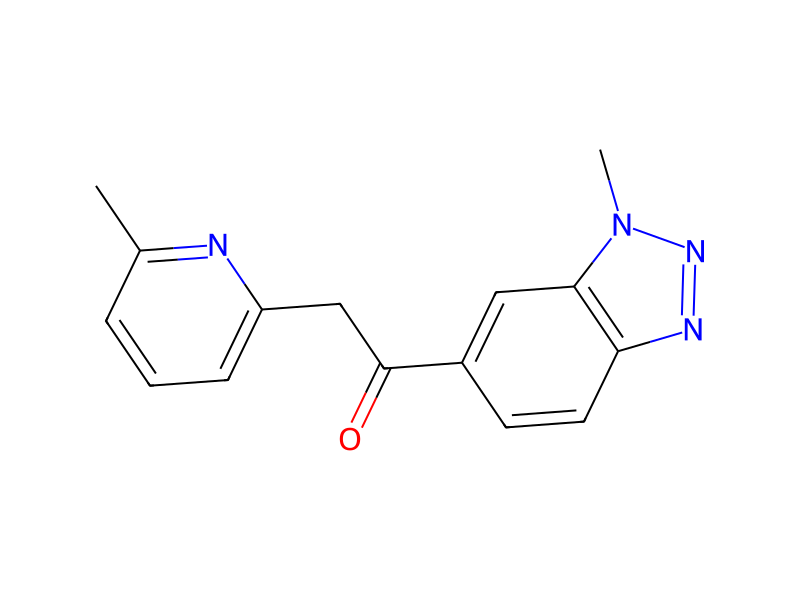
[CH3:1][N:2]1[C:6]2[CH:7]=[C:8]([C:11](=[O:20])[CH2:12][C:13]3[CH:18]=[CH:17][CH:16]=[C:15]([CH3:19])[N:14]=3)[CH:9]=[CH:10][C:5]=2[N:4]=[N:3]1.Br.O.C(=O)([O-])[OH:24].[Na+]>CS(C)=O>[CH3:1][N:2]1[C:6]2[CH:7]=[C:8]([C:11](=[O:20])[C:12]([C:13]3[CH:18]=[CH:17][CH:16]=[C:15]([CH3:19])[N:14]=3)=[O:24])[CH:9]=[CH:10][C:5]=2[N:4]=[N:3]1A solution of 1-(3-Methyl-3H-benzotriazol-5-yl)-2-(6-methyl-pyridin-2-yl)-ethanone (280 mg, 1.05 mmol) in 16 ml dimethyl sulfoxide was heated to 60° C. 48% hydrobromic acid solution in water (7.4 ml, 65.1 mmol) was slowly added over several minutes. Once the addition was complete, the reaction was stirred at 60° C. for 3 hours. The reaction was cooled to room temperature and poured into 75 ml water. The pH was adjusted to 8 with the addition of saturated sodium hydrogen carbonate solution. The aqueous layer was then extracted three times with ethyl acetate. The combined organics were dried over sodium sulfate, filtered and concentrated to afford 1-(3-Methyl-3H-benzotriazol-5-yl)-2-(6-methyl-pyridin-2-yl)-ethane-1,2-dione (146 mg, 50%).