Reaction equation

N[C@@H](CC(C)C)C(C1C=CC=CC=1)(C1C=CC=CC=1)O.C(O)(=O)C.[BH4-].[Na+].[Cl:27][C:28]1[CH:33]=[CH:32][C:31](/[CH:34]=[C:35](/[N:42]2[CH:46]=[N:45][CH:44]=[N:43]2)\[C:36](=[O:41])[C:37]([CH3:40])([CH3:39])[CH3:38])=[CH:30][CH:29]=1>C(Cl)Cl.CN(C)C=O.C(Cl)(Cl)Cl>[Cl:27][C:28]1[CH:33]=[CH:32][C:31](/[CH:34]=[C:35](/[N:42]2[CH:46]=[N:45][CH:44]=[N:43]2)\[CH:36]([OH:41])[C:37]([CH3:40])([CH3:39])[CH3:38])=[CH:30][CH:29]=1Participants
Reactant 4




Product 1
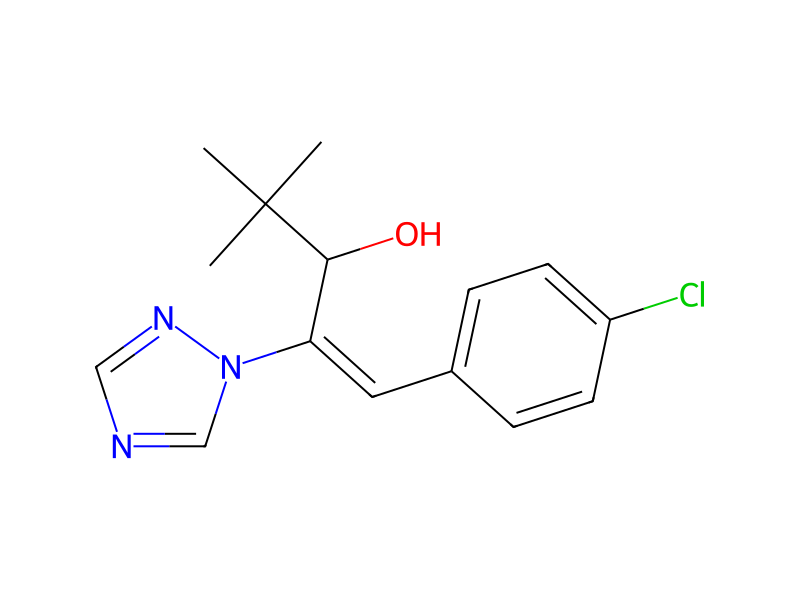
Reagents, catalysts & solvents 3



Conditions
- Temperature
- -60 °C
Procedure
To 3 ml of a chloroform solution containing 0.117 g (0.43 mmole) of (S)-2-amino-1,1-diphenyl-4-methylpentan-1-ol was added 0.052 g (0.87 mmole) of acetic acid, and the mixture was cooled to -60° C. Thereafter, 0.5 ml of a dimethylformamide solution containing 0.033 g (0.87 mmole) of sodium borohydride was added, and the temperature of the mixture was raised to room temperature over 2 hours. To this suspension was added 3 ml of a methylene chloride solution containing 0.084 g (0.29 mmole) of (E)-1-(4-chlorophenyl)-2-(1,2,4-triazol-1-yl)-4,4-dimethyl-1-penten-3-one, and stirring was carried out at room temperature for 17 hours. The same treatment as in Example 1 was applied to obtain (+)-(E)-1-(4-chlorophenyl)-2-(1,2,4-triazol-1-yl)-4,4-dimethyl-1-penten-3-ol. The conversion was 53.7%, and the composition of the product was: E-form alcohol, 85.4% and Z-form alcohol, 14.5%. The enantiomer ratio of the E-form alcohol was: (+)-isomer, 86.0% and (-)-isomer, 14.0%.
Workup
- additionwas added
- temperaturethe temperature of the mixture was raised to room temperature over 2 hours
Sources & evidence
- ORD record
- ord-ddcd8dbcdd3d4761a4eadab9d135db13
- Source dataset
- uspto-grants-1992_09
- Patent number
- US05144071
Linked notes
Loading…