HomeMCPWorkbenchSkills
HomeWorkbenchNotificationsMe
llms.txt · MCP GuidePrivacy Policy · Terms of Service · Supportv1.8.2
  1. Home
  2. /Reaction

Diisopropylethylamine → [(S)-1-[1-(2-hydroxy-2-methyl-propyl)-1H-pyrazol-3-ylcarbamoyl]-2-(tetrahydro-pyran-2-yl)-ethyl]-carbamic acid t-butyl ester

HRID 19032
Print

Reaction equation

HRID 19032 reaction equation
[C:1]([O:5][C:6]([NH:8][C@@H:9]([CH2:13][CH:14]1[CH2:19][CH2:18][CH2:17][CH2:16][O:15]1)[C:10]([OH:12])=O)=[O:7])([CH3:4])([CH3:3])[CH3:2].Cl.[OH:21][C@@H:22]([CH2:52]O)[CH2:23][N:24]1[CH:28]=[CH:27][C:26]([NH:29]C(=O)[C@@H](N2CC(OC3C=CC=C(Cl)C=3Cl)=CC2=O)CC(C)C)=[N:25]1.F[P-](F)(F)(F)(F)F.N1(O[P+](N(C)C)(N(C)C)N(C)C)C2C=CC=C[C:64]=2N=N1.C(N(CC)C(C)C)(C)C>CN(C)C=O>[C:1]([O:5][C:6](=[O:7])[NH:8][C@H:9]([C:10](=[O:12])[NH:29][C:26]1[CH:27]=[CH:28][N:24]([CH2:23][C:22]([OH:21])([CH3:52])[CH3:64])[N:25]=1)[CH2:13][CH:14]1[CH2:19][CH2:18][CH2:17][CH2:16][O:15]1)([CH3:2])([CH3:3])[CH3:4]

ParticipantsConditionsProcedureWorkupSources & evidenceReaction notes

Participants

6

Reactant 4

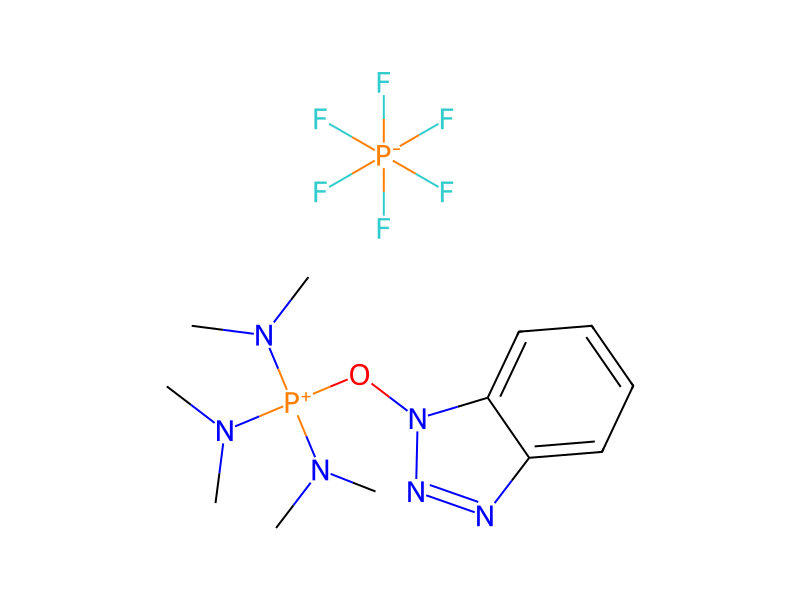
HCID 81531DiisopropylethylamineHCID 151348Benzotriazol-1-yloxy-tris(dimethylamino)phosphonium hexafluorophosphateHCID 59344958(S)-2-t-butoxycarbonylamino-3-(tetrahydro-pyran-2-yl)-propionic acidHCID 66899094HMS5552 HCl

Product 1

HCID 66899689
[(S)-1-[1-(2-hydroxy-2-methyl-propyl)-1H-pyrazol-3-ylcarbamoyl]-2-(tetrahydro-pyran-2-yl)-ethyl]-carbamic acid t-butyl ester
Yield 57.1%

Reagents, catalysts & solvents 1

HCID 6228DimethylformamideSolvent

Conditions

Temperature
0 °C

Procedure

To a solution of (S)-2-t-butoxycarbonylamino-3-(tetrahydro-pyran-2-yl)-propionic acid (700 mg, 2.56 mmol) in N,N-dimethylformamide (6 mL) was added 1-(3-amino-pyrazol-1-yl)-2-methyl-propan-2-ol (prepared in U.S. Pat. Appl. US2008021032 Example 80, 398 mg, 2.57 mmol) and benzotriazol-1-yl-oxy-tris(dimethylamino)phosphonium hexafluorophosphate (1.36 g, 3.0 mmol). The mixture was stirred at 0° C. and N,N-diisopropylethylamine (0.4 mL) was added. The mixture was stirred at room temperature overnight and solvents were evaporated. The residue was treated with ethyl acetate and ammonium chloride solution, and the organic layer separated. The organic layer was washed with saturated sodium chloride solution and dried over sodium sulfate. Solvents were evaporated and the residue was purified through flash column chromatography (silica gel, 5 to 100% ethyl acetate/hexanes) to afford [(S)-1-[1-(2-hydroxy-2-methyl-propyl)-1H-pyrazol-3-ylcarbamoyl]-2-(tetrahydro-pyran-2-yl)-ethyl]-carbamic acid t-butyl ester (600 mg, 57%) as a white solid: LR-ES-MS m/z calculated for C20H34N4O5 [M]+ 410, observed [M+H]+ 411.

Workup

  1. stirringThe mixture was stirred at room temperature overnight
  2. customsolvents were evaporated
  3. additionThe residue was treated with ethyl acetate and ammonium chloride solution
  4. customthe organic layer separated
  5. washThe organic layer was washed with saturated sodium chloride solution
  6. dry with materialdried over sodium sulfate
  7. customSolvents were evaporated
  8. customthe residue was purified through flash column chromatography (silica gel, 5 to 100% ethyl acetate/hexanes)

Sources & evidence

ORD record
ord-b4698883b4c94615acdc4ffcd0a8dce0
Source dataset
uspto-grants-2010_06
DOI
10.6084/m9.figshare.5104873.v1
Patent number
US07741327B2

Reaction notes

On this pageParticipantsConditionsProcedureWorkupSources & evidenceReaction notes
