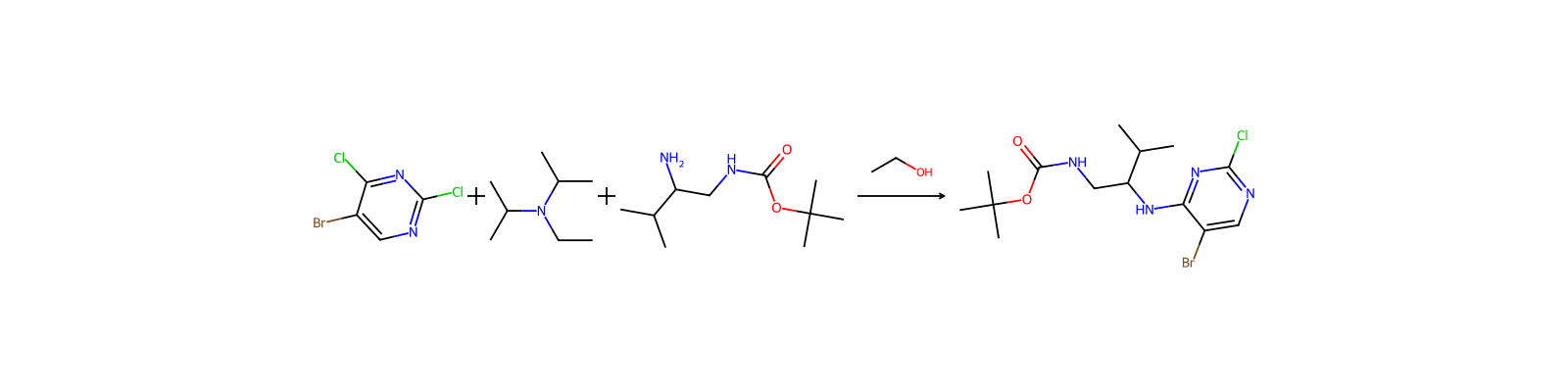
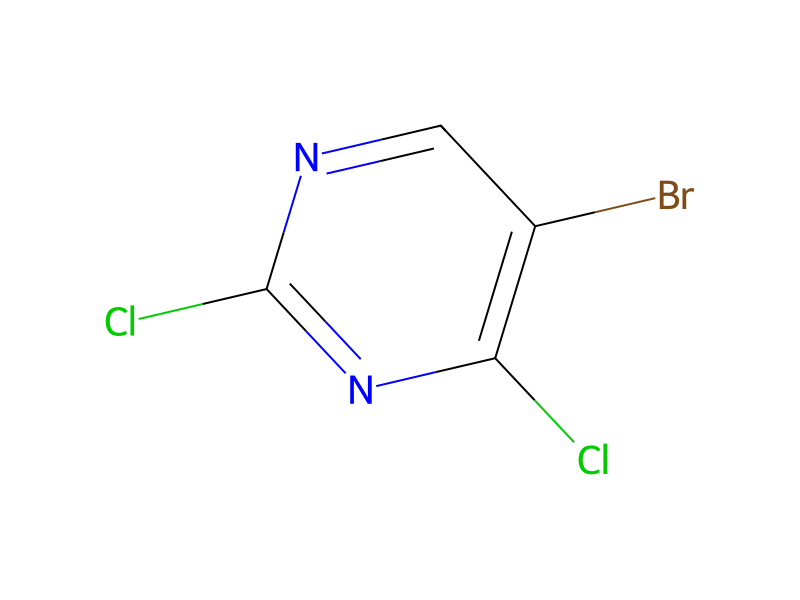
[Br:1][C:2]1[C:3](Cl)=[N:4][C:5]([Cl:8])=[N:6][CH:7]=1.C(N(C(C)C)CC)(C)C.[NH2:19][CH:20]([CH:30]([CH3:32])[CH3:31])[CH2:21][NH:22][C:23](=[O:29])[O:24][C:25]([CH3:28])([CH3:27])[CH3:26]>C(O)C>[Br:1][C:2]1[C:3]([NH:19][CH:20]([CH:30]([CH3:32])[CH3:31])[CH2:21][NH:22][C:23](=[O:29])[O:24][C:25]([CH3:26])([CH3:27])[CH3:28])=[N:4][C:5]([Cl:8])=[N:6][CH:7]=1To a solution of 5-bromo-2,4-dichloro-pyrimidine 7.11 g (0.0312 mole) in ethanol (100 mL) was added diisopropylethyl amine 5.45 mL (1.0 eq) and tert-butyl N-(2-amino-3-methyl-butyl)carbamate 6.31 g (0.0312 mole). The reaction mixture was stirred at room temperature for 20 hrs. After concentration under vacuum, ethyl acetate and water was added. The organic layer was separated, dried with magnesium sulfate and then concentrated under vacuum. The crude product was purified by column chromatography using hexane/ethyl acetate (0-30%) over silica gel to afford tert-butyl N-[2-[(5-bromo-2-chloro-pyrimidin-4-yl)amino]-3-methyl-butyl]carbamate. 1H NMR (600 MHz, DMSO-d6) δ ppm 0.77-0.85 (d, J=6.5 Hz, 3H) 0.87 (d, J=6.73 Hz, 3H) 1.31-1.39 (m, 9H) 1.82-1.93 (m, 1H) 2.94 (d, J=5.56 Hz, 1H) 3.08-3.22 (m, 2H) 3.98 (d, J=8.20 Hz, 1H) 6.96 (d, J=8.78 Hz, 1H) 8.21 (s, 1H). LCMS (ESI) 393 (M+H).