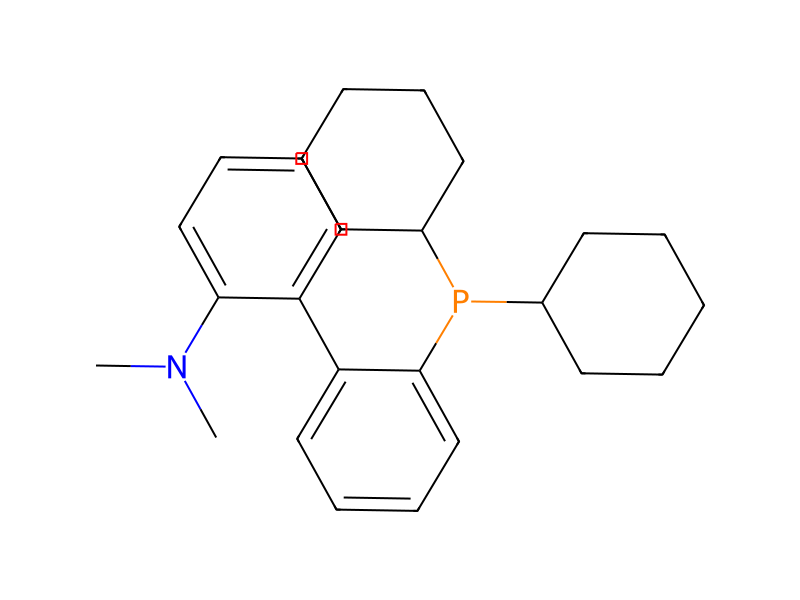
[CH3:1][C:2]1[CH:7]=[C:6]([CH3:8])[N:5]=[C:4]([N:9]2[CH2:14][CH2:13][NH:12][CH2:11][CH2:10]2)[CH:3]=1.Cl[C:16]1[CH:21]=[CH:20][C:19]([N+:22]([O-:24])=[O:23])=[CH:18][CH:17]=1.C(=O)([O-])[O-].[Cs+].[Cs+].C1(P(C2CCCCC2)C2C=CC=CC=2C2C=CC=CC=2N(C)C)CCCCC1>C1(C)C=CC=CC=1.C1COCC1.C([O-])(=O)C.[Pd+2].C([O-])(=O)C>[CH3:1][C:2]1[CH:7]=[C:6]([CH3:8])[N:5]=[C:4]([N:9]2[CH2:10][CH2:11][N:12]([C:16]3[CH:21]=[CH:20][C:19]([N+:22]([O-:24])=[O:23])=[CH:18][CH:17]=3)[CH2:13][CH2:14]2)[CH:3]=1To a solution of 1-(4,6-dimethyl-pyridin-2-yl)-piperazine (0.7 g, 3.66 mmol) and 1-chloro-4-nitro-benzene (0.69 g, 4.39 mmol) in toluene was added caesium carbonate (2.38 g, 7.32 mmol), then the mixture was stirred for 30 min. under an argon atmosphere. A solution of palladium(II) acetate (50 mg, 0.22 mmol) and (2′-dicyclohexylphosphanyl-biphenyl-2-yl)-dimethyl-amine (50 mg, 0.13 mmol) in THF was purged with argon for 30 min then added to the substrate mixture, and the resulting mixture was heated at 80° C. for 4 h. It was then allowed to cool and concentrated to dryness, and the resulting residue was diluted with water and extracted with ethyl acetate. The combined extracts were washed with brine, dried over sodium sulfate and concentrated in vacuo to a residue which was purified by column chromatography on silica gel (60-120 mesh) using 10% ethyl acetate/petroleum ether as eluent. This afforded 1-(4,6-dimethyl-pyridin-2-yl)-4-(4-nitro-phenyl)-piperazine (0.4 g, 35%).