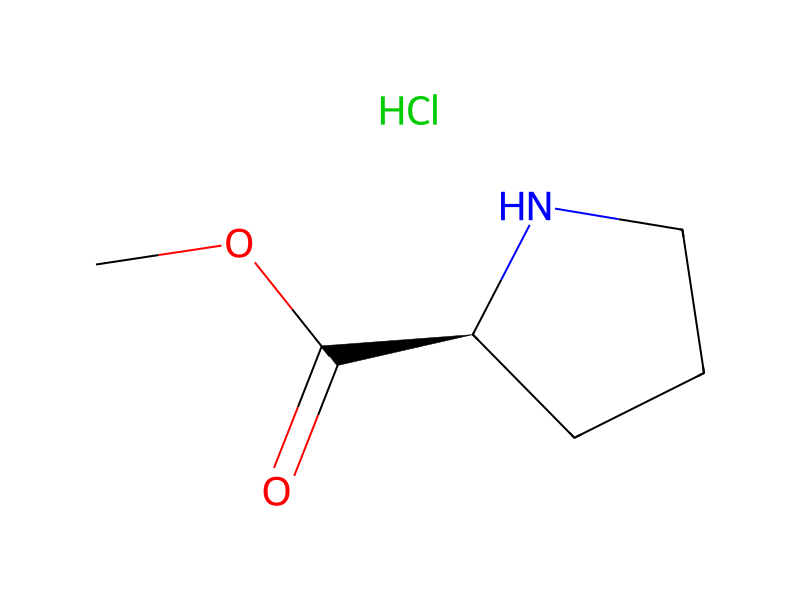
(S)-Methyl 1-(chlorocarbonyl)pyrrolidine-2-carboxylate was prepared following the procedure disclosed in U.S. Pat. No. 4,866,087 to Greenlee et al with minor modification. A solution of 5.63 g (19.0 mmol) bis(trichloromethyl carbonate in chloroform (15 mL) was added dropwise to a solution of (S)-Methyl pyrrolidine-2-carboxylate hydrochloride (2.62 g., 15.82 mmol) and diisopropylethylamine (11.0 mL, 63.28 mmol) in chloroform (15 mL) at ice-bath temperature. After one hour, the solution was washed with 1 N aqueous HCl and water, and dried over magnesium sulfate. The dried solution was concentrated and placed on a 85 mm i.d.×35 mm column of silica gel. The product was eluted in 20 percent ethyl acetate in hexanes and concentrated to a colorless oil. This was dissolved in chloroform (10 mL) and added to a suspension of 5-Chloro-N-(2-chloro-4-nitrophenyl)-2-hydroxybenzamide (645 mg, 1.97 mmol) in pyridine (15 mL) containing 20 mg of 4-dimethylaminopyridine. After stirring for 120 hours at room temperature, the reaction solution was partitioned between 1N aqueous HCl and ethyl acetate. The ethyl acetate phase was washed with water, then brine, and dried over magnesium sulfate. Concentration afforded an off-white solid which was recrystallized from ethyl acetate/hexanes. The 1H NMR spectrum is complex and reveals the existence of rotational isomers due to restricted rotation about the pyrrolidine-1-carboxylate bond. 1HNMR (300 MHz, DMSO-d6): δ 1.823-2.003 (m, 3H, pyrrolidine C4 methylene and pyrrolidine C3 syn-H), 2.213 (m, 1H, pyrrolidine C3 anti-H), 3.450 (m, 1H, pyrrolidine C5), 3.599 (m, 1H, pyrrolidine C5), 3.600 (s, 1.5H, methyl ester), 3.621 (s, 1.5H, methyl ester), 4.252 (m, 0.5H, pyrrolidine methine), 4.541 (m, 0.5H, pyrrolidine methine), 7.108 (d, J=8.5 Hz, 0.33H, H3), 7.216 (d, J=8.5 Hz, 0.33H, H3), 7.361 (d, J=9 Hz, 0.33H, H3), 7.545 (m, 0.33H, H4), 7.665 (m, 0.66H, H4), 7.763 (m, 0.66H, H6), 7.974 (m, 0.33H, H6), 8.133 (m, 0.66H, H6′), 8.287 (m, 1H, H5′), 8.302 (m, 0.33H, H3′), 8.539 (m, 0.33H, H3′), 8.446 (m, 0.33H, H3′), 8.822 (d, J=9.5 Hz, 0.33H, H6′), 10.313 (s, 0.33H, NH), 10.385 (s, 0.33H, NH), 11.367 (br s, 0.17H, NH), 12.519 (br s, 0.17H, NH).