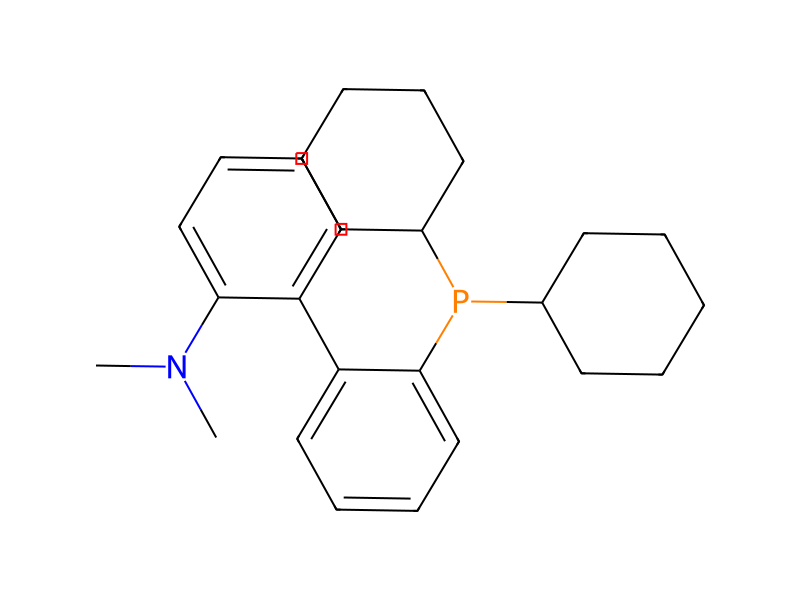
Br[C:2]1[CH:3]=[CH:4][C:5]([O:9][C:10]([F:13])([F:12])[F:11])=[C:6]([NH2:8])[CH:7]=1.[Li]N([Si](C)(C)C)[Si](C)(C)C.[CH3:24][N:25]1[CH2:30][CH2:29][NH:28][CH2:27][CH2:26]1>C1COCC1.C1C=CC(/C=C/C(/C=C/C2C=CC=CC=2)=O)=CC=1.C1C=CC(/C=C/C(/C=C/C2C=CC=CC=2)=O)=CC=1.C1C=CC(/C=C/C(/C=C/C2C=CC=CC=2)=O)=CC=1.[Pd].[Pd].C1(P(C2CCCCC2)C2C=CC=CC=2C2C=CC=CC=2N(C)C)CCCCC1>[CH3:24][N:25]1[CH2:30][CH2:29][N:28]([C:2]2[CH:3]=[CH:4][C:5]([O:9][C:10]([F:13])([F:12])[F:11])=[C:6]([NH2:8])[CH:7]=2)[CH2:27][CH2:26]1Tris(dibenzilideneacetone)dipalladium, Pd2(dba)3 (1.1 g, 1.2 mmol), 2-dicyclohexylphosphino-2′-(N,N-dimethylamino)-biphenyl (0.94 g, 2.4 mmol), 5-bromo-2-trifluoromethoxy-phenylamine (30.7 g, 120 mmol) in THF (50 mL) were charged in a round-bottom flask flushed with argon. The flask was evacuated and backfilled with argon. LiN(TMS)2 solution (1M in THF, 288 mL) and N-methylpiperazine (26.7 mL, 194 mmol) were added and the reaction refluxed for 1 h. The reaction mixture was then allowed to cool to room temperature and filtered through a pad of celite. The organic phase was concentrated, the residue dissolved in DCM (200 ml) and washed with water (1×100 ml). The organic phases were dried over anhydrous Na2SO4, the solvent evaporated in vacuo and the crude solid was purified by flash chromatography on silica gel (eluant: DCM/EtOH 90/10) to afford 21.1 g of 5-(4-methyl-piperazin-1-yl)-2-trifluoromethoxy-phenylamine (64% yield) as a light brown powder.
Loading…