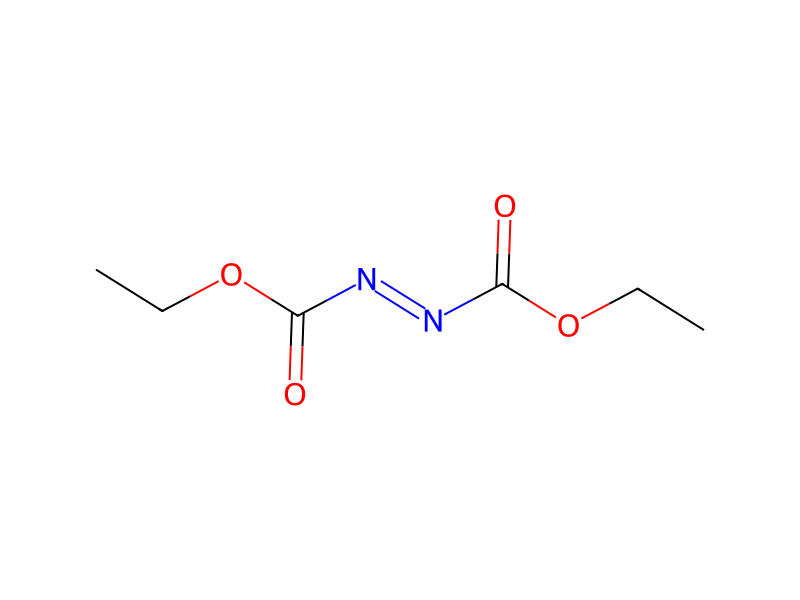
[OH:1][C:2]1[CH:3]=[CH:4][C:5]([N+:12]([O-:14])=[O:13])=[C:6]([CH:11]=1)[C:7]([O:9][CH3:10])=[O:8].C1(P(C2C=CC=CC=2)C2C=CC=CC=2)C=CC=CC=1.[CH2:34]([O:41][CH2:42][CH2:43]O)[C:35]1[CH:40]=[CH:39][CH:38]=[CH:37][CH:36]=1.CCOC(/N=N/C(OCC)=O)=O>O1CCCC1>[CH2:34]([O:41][CH2:42][CH2:43][O:1][C:2]1[CH:3]=[CH:4][C:5]([N+:12]([O-:14])=[O:13])=[C:6]([CH:11]=1)[C:7]([O:9][CH3:10])=[O:8])[C:35]1[CH:40]=[CH:39][CH:38]=[CH:37][CH:36]=1To a solution of methyl 5-hydroxy-2-nitro-benzoate (7.97 g, 40.43 mmol), triphenylphosphine (12.73 g, 48.53 mmol), and 2-benzyloxyethanol (5.86 ml, 41.24 mmol) in tetrahydofuran (100 ml) was added DEAD (8.04 ml, 95%, 48.51 mmol) dropwise. After addition of the DEAD, the reaction was stirred under nitrogen for 18 h. The solvent was evaporated, benzene was added, and the triphenylphosphine oxide was filtered off. The solid was washed with some benzene, and the filtrate evaporated. The yellow oil was dissolved in minimal benzene, and chromatographed on silica gel eluting with 25% ethyl acetate/hexanes to give methyl 5-(2-benzyloxy-ethoxy)-2-nitro-benzoate (12.47 g, 93%) as a light yellow oil. Analysis calculated for C17H17NO6 : C, 61.63; H, 5.17; N, 4.23. Found: C, 61.46; H, 5.02; N, 4.28.