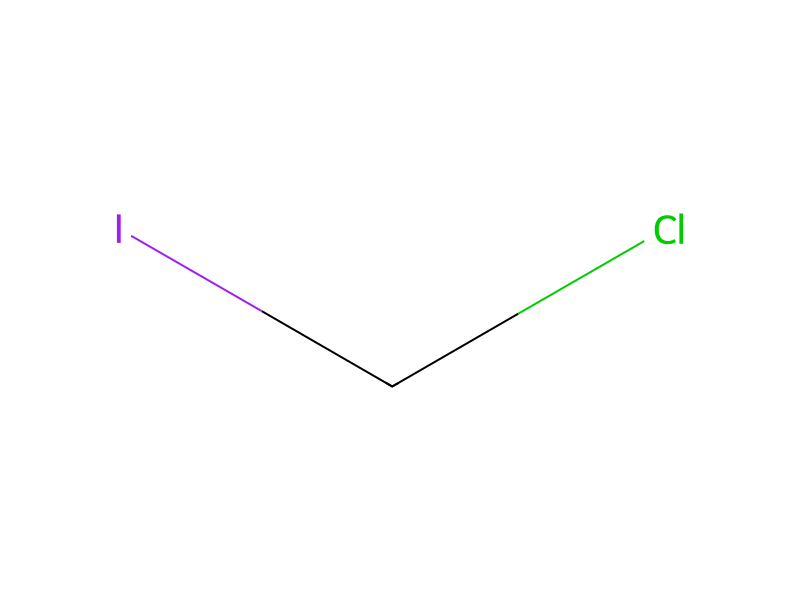
[Br:1][C:2]1[CH:7]=[CH:6][C:5]([CH:8]2[C:16]3[C:11](=[CH:12][CH:13]=[CH:14][CH:15]=3)[N:10]([CH2:17][C:18]3[O:19][C:20]([C:23]([F:26])([F:25])[F:24])=[CH:21][CH:22]=3)[C:9]2=[O:27])=[C:4]([OH:28])[CH:3]=1.Cl[CH2:30]I.C(=O)([O-])[O-].[Cs+].[Cs+]>O1CCCC1>[Br:1][C:2]1[CH:7]=[CH:6][C:5]2[C:8]3([CH2:30][O:28][C:4]=2[CH:3]=1)[C:16]1[C:11](=[CH:12][CH:13]=[CH:14][CH:15]=1)[N:10]([CH2:17][C:18]1[O:19][C:20]([C:23]([F:26])([F:25])[F:24])=[CH:21][CH:22]=1)[C:9]3=[O:27]To a stirred solution of 3-(4-bromo-2-hydroxyphenyl)-1-{[5-(trifluoromethyl)furan-2-yl]methyl}-1,3-dihydro-2H-indol-2-one (4.3 g, 9.5 mmol), chloroiodomethane (1.8 mL, 25.3 mmol) in tetrahydrofuran (100 mL) was added cesium carbonate (9.9 g, 30.5 mmol) under Argon. The mixture was stirred at ambient temperature for 16 h, then filtered through a pad of celite. The filtrate was concentrated under vacuum. The residue was treated with diethyl ether/hexanes to afford 6-bromo-1′-{[5-(trifluoromethyl)furan-2-yl]methyl}spiro[1-benzofuran-3,3′-indol]-2′(1′H)-one (3.46 g, 78%) as a colorless solid: 1H NMR (300 MHz, CDCl3) δ7.30 (td, J=7.9, 1.5 Hz, 1H), 7.16-7.03 (m, 3H), 6.69 (d, J=7.9 Hz, 1H), 6.93 (dd, J=8.2, 1.8 Hz, 1H), 6.77-6.71 (m, 1H), 6.53 (d, J=8.2 Hz, 1H), 6.42-6.37 (m, 1H), 5.06 (d, J=16.1 Hz, 1H), 4.97 (d, J=9.4 Hz, 1H), 4.86 (d, J=16.1 Hz, 1H), 4.71 (d, J=9.4 Hz, 1H); 13C NMR (75 MHz, CDCl3) δ176.5, 161.5, 151.8, 141.4, 131.6, 129.3, 128.0, 124.5 (d), 124.0, 114.2, 112.6 (d), 109.2 (d), 80.1, 57.5, 36.9; MS (ES+) m/z 463.9 (M+1), 465.9 (M+1).
Loading…