HomeMCPWorkbenchSkills
HomeWorkbenchNotificationsMe
llms.txt · MCP GuidePrivacy Policy · Terms of Service · Supportv1.8.3
  1. Home
  2. /Reaction

Triethylamine → 4-Chloro-5-[3-(4-cyclopropyl-3,4-dihydro-2H-quinoxaline-1-carbonyl)-pyridin-4-yloxy]-phthalic acid dimethyl ester

HRID 1967007
Print

Reaction equation

HRID 1967007 reaction equation
Br[C:2]1[C:29](Cl)=[CH:28][C:5]([O:6][C:7]2[CH:12]=[CH:11][N:10]=[CH:9][C:8]=2[C:13]([N:15]2[C:24]3[C:19](=[CH:20][CH:21]=[CH:22][CH:23]=3)[N:18]([CH:25]3[CH2:27][CH2:26]3)[CH2:17][CH2:16]2)=[O:14])=[C:4]([Cl:31])[CH:3]=1.C(N(CC)CC)C.[C]=O.[C:41]([O:44][CH2:45]C)(=[O:43])C>ClCCl.[Pd](Cl)Cl.C1(P(C2C=CC=CC=2)[C-]2C=CC=C2)C=CC=CC=1.[C-]1(P(C2C=CC=CC=2)C2C=CC=CC=2)C=CC=C1.[Fe+2]>[CH3:45][O:44][C:41](=[O:43])[C:29]1[C:2](=[CH:3][C:4]([Cl:31])=[C:5]([O:6][C:7]2[CH:12]=[CH:11][N:10]=[CH:9][C:8]=2[C:13]([N:15]2[C:24]3[C:19](=[CH:20][CH:21]=[CH:22][CH:23]=3)[N:18]([CH:25]3[CH2:26][CH2:27]3)[CH2:17][CH2:16]2)=[O:14])[CH:28]=1)[C:41]([O:44][CH3:45])=[O:43]
ParticipantsConditionsProcedureWorkupSources & evidenceReaction notes

Participants

6

Reactant 4

HCID 8471TriethylamineHCID 8857Ethyl AcetateHCID 53312111[4-(4-Bromo-2,5-dichloro-phenoxy)-pyridin-3-yl]-(4-cyclopropyl-3,4-dihydro-2H-quinoxalin-1-yl)-methanoneHCID 178418416HCID 178418416, compound

Product 1

HCID 533121934-Chloro-5-[3-(4-cyclopropyl-3,4-dihydro-2H-quinoxaline-1-carbonyl)-pyridin-4-yloxy]-phthalic acid dimethyl ester

Reagents, catalysts & solvents 1

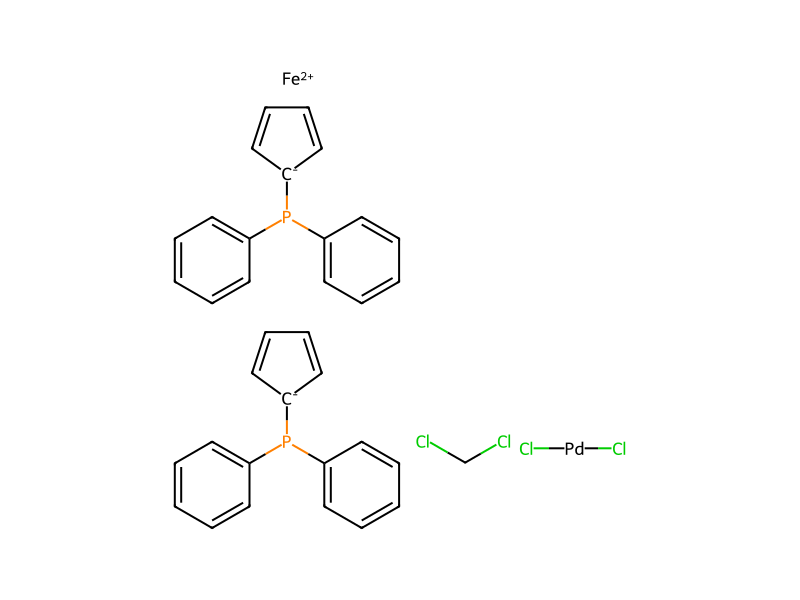
HCID 178418807HCID 178418807, compoundCatalyst

Conditions

Temperature
120 °C

Procedure

To a solution of 1.0 g (1.93 mmol) [4-(4-bromo-2,5-dichloro-phenoxy)-pyridin-3-yl]-(4-cyclopropyl-3,4-dihydro-2H-quinoxalin-1-yl)-methanone in 25 mL methanole and 25 mL ethyl acetate were added 0.40 mL (2.89 mmol) triethylamine and 0.094 g (0.12 mmol) 1,1′-bis(diphenylphosphino)ferrocene-palladium(II) dichloride dichloromethane adduct (commercially available, CAS RN 851232-71-8). Then, a 70 bar carbon monoxide atmosphere was installed and the reaction mixture was stirred at 120° C. for 20 hours. After cooling down, the reaction mixture was filtered and the filtrate was treated with silica gel and evaporated. The resulting powder was then purified by silica gel chromatography using a MPLC system (50 g silica gel column, CombiFlash Companion, Isco Inc.) eluting with a gradient of n-heptane:ethyl acetate (100:0 to 50:50) to give a first batch of each compound. The remaining fractions containing impurities were combined and again chromatographed (20 g silica gel column, CombiFlash Companion, Isco Inc.) using a gradient of n-heptane:ethyl acetate (100:0 to 40:60) to give a second batch of the desired compounds.

Workup

  1. temperatureAfter cooling down
  2. filtrationthe reaction mixture was filtered
  3. additionthe filtrate was treated with silica gel
  4. customevaporated
  5. customThe resulting powder was then purified by silica gel chromatography
  6. washeluting with a gradient of n-heptane:ethyl acetate (100:0 to 50:50)
  7. customto give a first batch of each compound
  8. additionThe remaining fractions containing impurities
  9. customagain chromatographed (20 g silica gel column, CombiFlash Companion, Isco Inc.)

Sources & evidence

ORD record
ord-6cd4e0ce38694fa3841d0e8341fbc127
Source dataset
uspto-grants-2013_04
DOI
10.6084/m9.figshare.5104873.v1
Patent number
US08420647B2

Reaction notes

On this pageParticipantsConditionsProcedureWorkupSources & evidenceReaction notes