Reaction equation
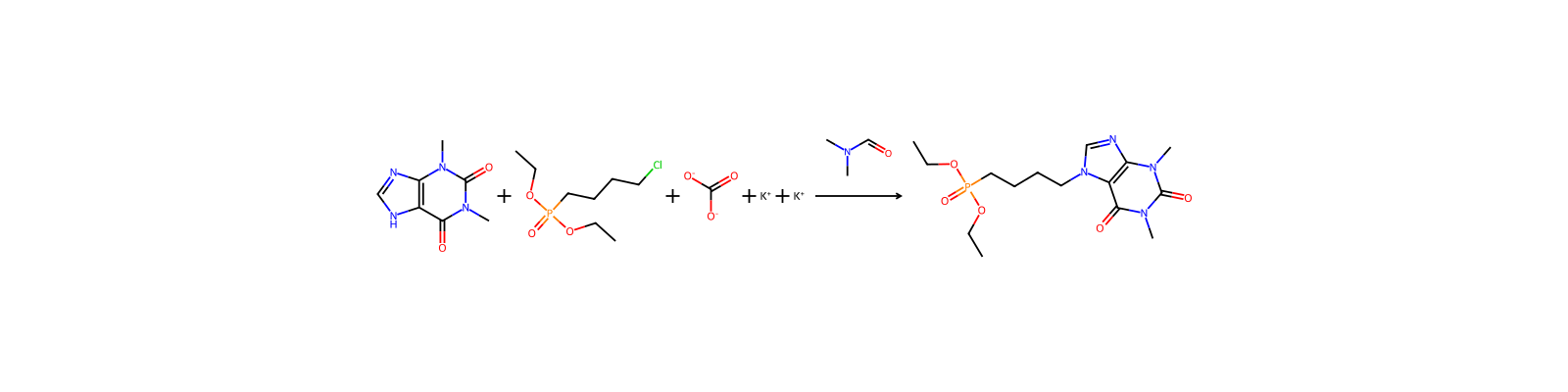
[CH3:1][N:2]1[C:11](=[O:12])[C:10]2[NH:9][CH:8]=[N:7][C:6]=2[N:5]([CH3:13])[C:3]1=[O:4].Cl[CH2:15][CH2:16][CH2:17][CH2:18][P:19]([O:24][CH2:25][CH3:26])(=[O:23])[O:20][CH2:21][CH3:22].C(=O)([O-])[O-].[K+].[K+]>CN(C=O)C>[CH3:1][N:2]1[C:11](=[O:12])[C:10]2[N:9]([CH2:15][CH2:16][CH2:17][CH2:18][P:19](=[O:23])([O:24][CH2:25][CH3:26])[O:20][CH2:21][CH3:22])[CH:8]=[N:7][C:6]=2[N:5]([CH3:13])[C:3]1=[O:4]Participants
5
Reactant 3



Product 1

Reagents, catalysts & solvents 1

Conditions
- Temperature
- 70 °C
Procedure
10.9 g (0.05 mol) of 1,3-dimethylxanthine were suspended in 150 ml of DMF, treated with 13.7 g (0.06 mol) of diethyl 4-chlorobutanephosphonate and 7.0 g (0.05 mol) of activated potassium carbonate and heated at 70° C. for approximately 4 hours. The solid was then filtered off, the filtrate was concentrated under reduced pressure and the oily residue which remained was taken up in ethyl acetate, filtered again and crystallized from diisopropyl ether.
Workup
- filtrationThe solid was then filtered off
- concentrationthe filtrate was concentrated under reduced pressure
- filtrationfiltered again
- customcrystallized from diisopropyl ether
Sources & evidence
- ORD record
- ord-126b62e8f9c14b19bd96ee46b744d0b7
- Source dataset
- uspto-grants-1998_03
- Patent number
- US05728686
Linked notes
Loading…