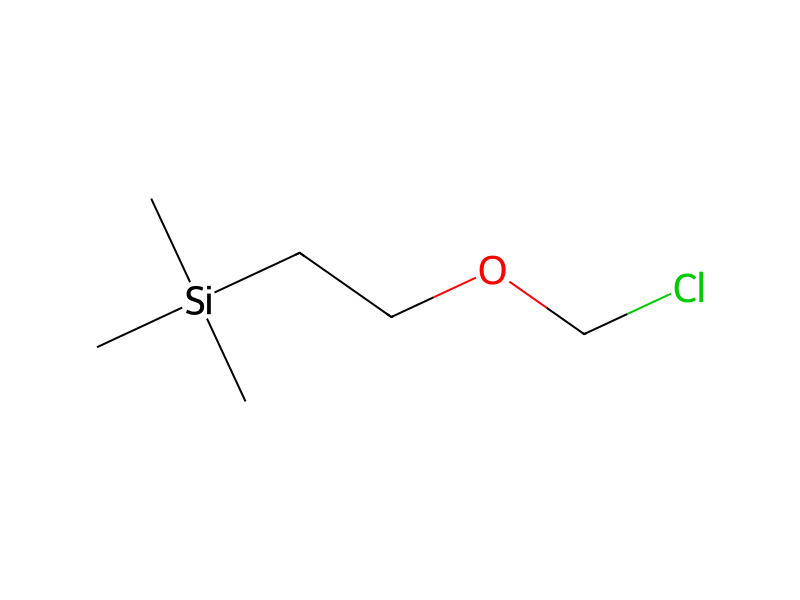
[Br:1][C:2]1[CH:3]=[N:4][NH:5][CH:6]=1.C([O-])([O-])=O.[K+].[K+].[CH3:13][Si:14]([CH3:21])([CH3:20])[CH2:15][CH2:16][O:17][CH2:18]Cl>CN(C=O)C>[Br:1][C:2]1[CH:3]=[N:4][N:5]([CH2:18][O:17][CH2:16][CH2:15][Si:14]([CH3:21])([CH3:20])[CH3:13])[CH:6]=1To a 100 mL roundbottom flask was charged 4-bromopyrazole (13.6 mmol, 2.00 g), K2CO3 (20.4 mmol, 2.82 g), and DMF (20 mL). To this suspension was added 2-(trimethylsilyl)ethoxymethyl chloride (15.0 mmol, 2.64 mL). This suspension was allowed to stir at room temperature 18 hours. The reaction mixture was then concentrated in vacuo, dissolved in 20 mL DCM, and filtered through celite. The crude mixture was purified via silica gel chromatography (0% to 80% ethyl acetate in hexanes gradient) to yield 4-bromo-1-((2-(trimethylsilyl)ethoxy)methyl)-1H-pyrazole (2.53 g, 9.12 mmol, 67% yield) as clear oil.