Reaction equation
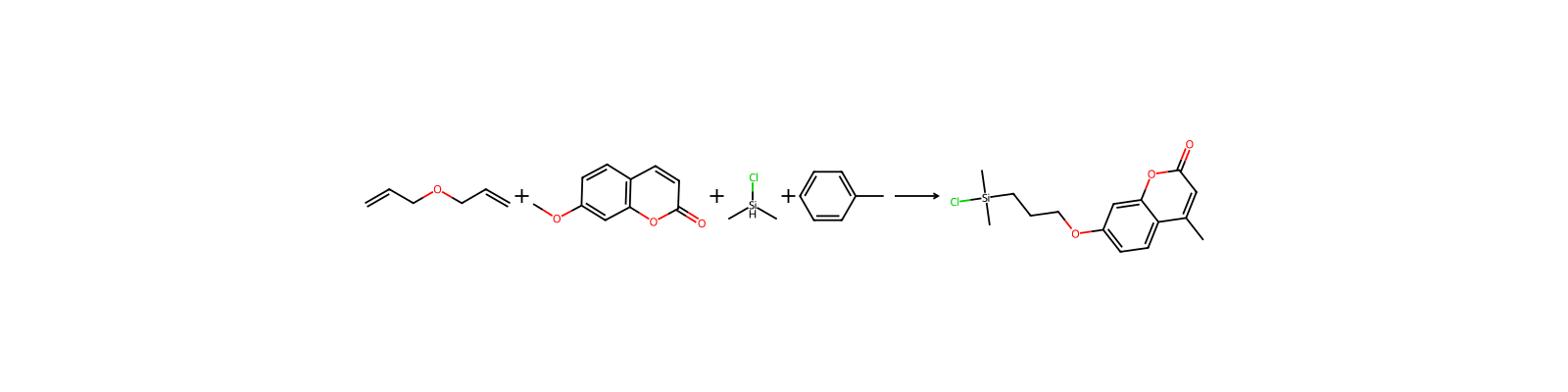
[CH2:1]([O:4][CH2:5][CH:6]=[CH2:7])[CH:2]=[CH2:3].COC1C=C[C:13]2[CH:16]=[CH:17][C:18]([O:20][C:12]=2[CH:11]=1)=[O:19].[CH3:21][SiH:22]([CH3:24])[Cl:23].[C:25]1(C)C=CC=CC=1>>[Cl:23][Si:22]([CH3:24])([CH3:21])[CH2:3][CH2:2][CH2:1][O:4][C:5]1[CH:11]=[C:12]2[C:13]([C:16]([CH3:25])=[CH:17][C:18](=[O:19])[O:20]2)=[CH:7][CH:6]=1Participants



Conditions
- Temperature
- 110 °C
Procedure
A 1 L 3-necked flask fitted with condenser, thermometer and addition funnel was charged with 87 g (0.4 mol) of the allyl ether of methylumbelliferone formed by Step 1 and 200 ml toluene. While stirring the contents, 15 ml dimethylchlorosilane and 0.5 ml H2PtCl6 were added. With warming of the reaction mixture by an IR lamp, the reaction initiated at 70 degrees C. and quickly rose to 105 degrees C. with reflux. The addition of 40 additional grams of dimethylchlorosilane (0.5 mol total) was adjusted to produce gentle reflux (30 minutes), followed by stirring at 110 degrees C. for 1 hour. The reaction mixture was cooled to room temperature, and the toluene was removed under reduced pressure. The last traces of solvent were removed under high vacuum. The residue (120 g) was dissolved in 1200 ml of acetonitrile for storage and handling. The substitution of DMSO for THF as the solvent in Step 1 eliminated the need for pressure in Step 2 and made the second step generally run cleaner.
Workup
- customA 1 L 3-necked flask fitted with condenser
- additionthermometer and addition funnel
- additionwere added
- temperatureWith warming of the reaction mixture by an IR lamp
- custominitiated at 70 degrees C
- customquickly rose to 105 degrees C
- temperaturewith reflux
- customto produce gentle
- temperaturereflux (30 minutes)
- temperatureThe reaction mixture was cooled to room temperature
- customthe toluene was removed under reduced pressure
- customThe last traces of solvent were removed under high vacuum
- dissolutionThe residue (120 g) was dissolved in 1200 ml of acetonitrile for storage and handling
Sources & evidence
- ORD record
- ord-47c08a553c754525aee74e65b212226e
- Source dataset
- uspto-grants-1990_04
- Patent number
- US04918200
Linked notes
Loading…