HomeMCPSkillsWorkbenchOpenChem
HomeWorkbenchNotificationsMe
llms.txt · skill.md · MCP GuidePrivacy Policy · Terms of Service · Supportv1.8.5
  1. Home
  2. /Reaction

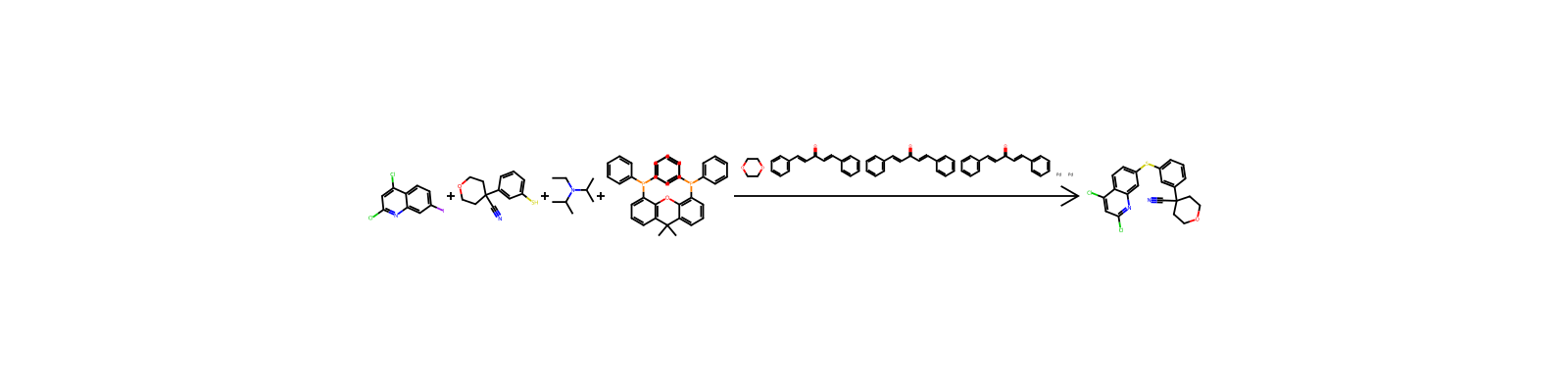
Diisopropylethylamine → 4-[3-(2,4-Dichloro-quinolin-7-ylsulfanyl)-phenyl]-tetrahydro-pyran-4-carbonitrile

HRID 2075673
Print

Reaction equation

[Cl:1][C:2]1[CH:11]=[C:10]([Cl:12])[C:9]2[C:4](=[CH:5][C:6](I)=[CH:7][CH:8]=2)[N:3]=1.[SH:14][C:15]1[CH:16]=[C:17]([C:21]2([C:27]#[N:28])[CH2:26][CH2:25][O:24][CH2:23][CH2:22]2)[CH:18]=[CH:19][CH:20]=1.CCN(C(C)C)C(C)C.C1(P(C2C=CC=CC=2)C2C3OC4C(=CC=CC=4P(C4C=CC=CC=4)C4C=CC=CC=4)C(C)(C)C=3C=CC=2)C=CC=CC=1>O1CCOCC1.C1C=CC(/C=C/C(/C=C/C2C=CC=CC=2)=O)=CC=1.C1C=CC(/C=C/C(/C=C/C2C=CC=CC=2)=O)=CC=1.C1C=CC(/C=C/C(/C=C/C2C=CC=CC=2)=O)=CC=1.[Pd].[Pd]>[Cl:1][C:2]1[CH:11]=[C:10]([Cl:12])[C:9]2[C:4](=[CH:5][C:6]([S:14][C:15]3[CH:16]=[C:17]([C:21]4([C:27]#[N:28])[CH2:22][CH2:23][O:24][CH2:25][CH2:26]4)[CH:18]=[CH:19][CH:20]=3)=[CH:7][CH:8]=2)[N:3]=1
ParticipantsConditionsProcedureWorkupSources & evidenceReaction notes

Participants

7

Reactant 4

HCID 81531DiisopropylethylamineHCID 6360441,1'-(9,9-Dimethyl-9H-xanthene-4,5-diyl)bis(1,1-diphenylphosphine)HCID 187863864-(3-Mercapto-phenyl)-tetrahydro-pyran-4-carbonitrileHCID 866138212,4-Dichloro-7-iodo-quinoline

Product 1

HCID 866138254-[3-(2,4-Dichloro-quinolin-7-ylsulfanyl)-phenyl]-tetrahydro-pyran-4-carbonitrile

Reagents, catalysts & solvents 2

HCID 9811564Bis(dibenzylideneacetone)palladiumCatalystHCID 312751,4-DioxaneSolvent

Conditions

Temperature
60 °C

Procedure

2,4-Dichloro-7-iodo-quinoline (3.4 g, 10.5 mmol), 4-(3-mercapto-phenyl)-tetrahydro-pyran-4-carbonitrile (3a, 2.3 g, 10.5 mmol), iPr2NEt (3.67 mL, 21.0 mmol), Pd2dba3 (240 mg, 0.26 mmol), and 4,5-bis(diphenylphosphino)-9,9-dimethylxanthene (303 mg, 0.52 mmol) were dissolved in 1,4-dioxane (50 mL) and degassed for 10 minutes with N2. The reaction was then sealed and heated to 60° C. for 1 hour. After cooling to room temperature, the reaction was diluted with EtOAc and saturated aqueous NH4Cl. The aqueous layer was extracted with EtOAc, and the combined organic layers were dried over MgSO4, filtered, and concentration. The residue was purified by silica gel chromatography (30% EtOAc in hexanes) to give the desired product, 3b.

Workup

  1. customdegassed for 10 minutes with N2
  2. customThe reaction was then sealed
  3. temperatureAfter cooling to room temperature
  4. additionthe reaction was diluted with EtOAc and saturated aqueous NH4Cl
  5. extractionThe aqueous layer was extracted with EtOAc
  6. dry with materialthe combined organic layers were dried over MgSO4
  7. filtrationfiltered
  8. concentrationconcentration
  9. customThe residue was purified by silica gel chromatography (30% EtOAc in hexanes)

Sources & evidence

ORD record
ord-f7cf6a8aff294b7da929f79cd5125135
Source dataset
uspto-grants-2011_04
DOI
10.6084/m9.figshare.5104873.v1
Patent number
US07919621B2

Reaction notes

On this pageParticipantsConditionsProcedureWorkupSources & evidenceReaction notes