HomeMCPWorkbenchSkills
HomeWorkbenchNotificationsMe
llms.txt · MCP GuidePrivacy Policy · Terms of Service · Supportv1.8.0
  1. Home
  2. /Reaction

Sodium Hydroxide → 5-(4-Bromo-2-fluoro-phenylamino)-8-fluoro-imidazo[1,5-a]pyridine-6-carboxylic acid ((S)-2-hydroxy-propoxy)-amide

HRID 2076206
Notes
Print preview

Reaction equation

HRID 2076206 reaction equation
CO[C:3]([C:5]1[CH:6]=[C:7]([F:23])[C:8]2[N:9]([CH:20]=[N:21][CH:22]=2)[C:10]=1[NH:11][C:12]1[CH:17]=[CH:16][C:15]([Br:18])=[CH:14][C:13]=1[F:19])=[O:4].[OH-].[Na+].CCN=C=NCCCN(C)C.C1C=CC2N(O)N=NC=2C=1.Cl.[NH2:48][O:49][CH2:50][C@@H:51]([OH:53])[CH3:52].CCN(C(C)C)C(C)C>>[OH:53][C@@H:51]([CH3:52])[CH2:50][O:49][NH:48][C:3]([C:5]1[CH:6]=[C:7]([F:23])[C:8]2[N:9]([CH:20]=[N:21][CH:22]=2)[C:10]=1[NH:11][C:12]1[CH:17]=[CH:16][C:15]([Br:18])=[CH:14][C:13]=1[F:19])=[O:4]
ParticipantsConditionsProcedureWorkupSources & evidenceReaction notes

Participants

7

Reactant 6

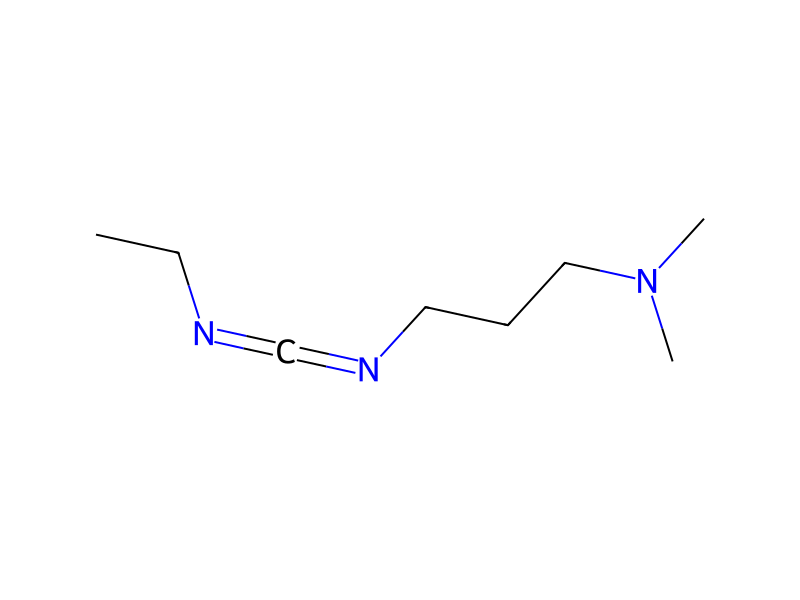
HCID 14798Sodium HydroxideHCID 159081-Ethyl-3-(3'-dimethylaminopropyl)carbodiimideHCID 757711-HydroxybenzotriazoleHCID 81531DiisopropylethylamineHCID 591401675-(4-Bromo-2-fluoro-phenylamino)-8-fluoro-imidazo[1,5-a]pyridine-6-carboxylic acid methyl esterHCID 86637725(S)-1-aminooxypropan-2-ol hydrochloride

Product 1

HCID 591401615-(4-Bromo-2-fluoro-phenylamino)-8-fluoro-imidazo[1,5-a]pyridine-6-carboxylic acid ((S)-2-hydroxy-propoxy)-amideYield 30.5%

Conditions

Temperature
65 °C

Procedure

To a solution of 5-(4-bromo-2-fluoro-phenylamino)-8-fluoro-imidazo[1,5-a]pyridine-6-carboxylic acid methyl ester (351 mg, 0.92 mmol) in IMS (10 mL) was added sodium hydroxide (1.0 mL, 1M aqueous solution, 1.0 mmol). The reaction mixture was heated at 65° C. for 1 hour, and then concentrated in vacuo. The resultant residue was azeotroped with toluene and then suspended in dioxane. EDCI (353 mg, 1.84 mmol) and HOBt (248 mg, 1.84 mmol) were added and the mixture was stirred at room temperature for 20 minutes. (S)-1-Aminooxy-propan-2-ol hydrochloride (235 mg, 1.84 mmol) and DIPEA (0.63 mL, 3.68 mmol) were added and the resultant mixture was stirred for 18 hours, before being concentrated under reduced pressure. The resultant residue was taken up in ethyl acetate then washed with a saturated aqueous solution of sodium bicarbonate followed by water and brine. The organic phase was isolated, dried (Na2SO4), filtered and concentrated in vacuo. The resultant residue was subjected to flash chromatography (Si-PPC, gradient 0 to 10%, methanol in dichloromethane) to give a pale yellow solid (124 mg), which was further purified by preparative HPLC (Gemin 5 micron C18 250×21.20 mm column, 0.1% formic acid, gradient acetonitrile/water, 5 to 85%, ramp time 15 minutes) to afford the title compound as an off-white solid (70 mg, 17%). LCMS (method A): RT=7.83 min, [M+H]+=441/443. 1H NMR (CDCl3): 9.45 (1H, s), 8.99 (1H, s), 7.76 (1H, d, J=2.95 Hz), 7.59 (1H, s), 7.29 (1H, dd, J=10.10, 2.16 Hz), 7.12 (1H, d, J=8.52 Hz), 6.50 (1H, d, J=10.18 Hz), 6.41 (1H, t, J=8.54 Hz), 4.03 (1H, t, J=7.52 Hz), 3.94 (1H, d, J=11.57 Hz), 3.70 (1H, t, J=10.24 Hz), 1.14 (3H, d, J=6.46 Hz).

Workup

  1. concentrationconcentrated in vacuo
  2. customThe resultant residue was azeotroped with toluene
  3. concentrationbefore being concentrated under reduced pressure
  4. washthen washed with a saturated aqueous solution of sodium bicarbonate
  5. customThe organic phase was isolated
  6. dry with materialdried (Na2SO4)
  7. filtrationfiltered
  8. concentrationconcentrated in vacuo

Sources & evidence

ORD record
ord-26c67504bc794c92a9667e252cc9570c
Source dataset
uspto-grants-2011_04
DOI
10.6084/m9.figshare.5104873.v1
Patent number
US07923456B2

Reaction notes

Loading…

On this pageParticipantsConditionsProcedureWorkupSources & evidenceReaction notes