Phosgene → o-sec-Butylphenyl chloroformate
Reaction equation

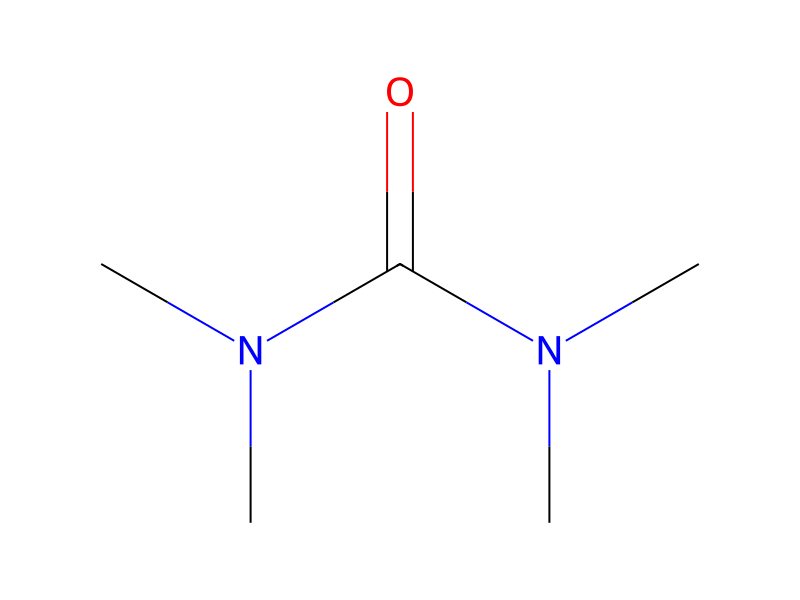
[C:1]([Cl:4])(Cl)=[O:2].[CH:5]([C:9]1[CH:14]=[CH:13][CH:12]=[CH:11][C:10]=1[OH:15])([CH2:7][CH3:8])[CH3:6].CN(C)C(N(C)C)=O>>[CH:5]([C:9]1[CH:14]=[CH:13][CH:12]=[CH:11][C:10]=1[O:15][C:1]([Cl:4])=[O:2])([CH2:7][CH3:8])[CH3:6]Participants



Conditions
- Temperature
- 100 °C
Procedure
In a round flask provided with stirrer, thermometer, an introduction tube for phosgene and a reflux cooler operating at about -30° C a mixture of 150 g of o-sec.-butylphenol and 4 g of N,N,N',N',-tetramethyl urea was heated at 100° C and phosgene was introduced to such a degree that the phosgene reflux in the deep-freezing cooler did not increase so much as to reduce the sump temperature. After a reaction time of about 5 hours and a phosgene consumption of about 190 g the reflux cooler was replaced by a descending cooler so that the greatest part of the excess phosgene could be separated from the reaction mixture by distillation. The rest of phosgene was blown out with dry nitrogen. Thus, a yield of about 97% of chloroformic acid-o-sec.-butyl-phenyl-ester was obtained which was practically free from the starting product (GC).
Workup
- customIn a round flask provided with stirrer
- temperaturereflux in the deep-freezing cooler
- temperaturedid not increase so much as
- customAfter a reaction time of about 5 hours and a phosgene consumption of about 190 g the reflux cooler
- customcould be separated from the reaction mixture by distillation
Sources & evidence
- ORD record
- ord-0b051d0a67eb4ffab9a74e8ad4b9d465
- Source dataset
- uspto-grants-1978_04
- Patent number
- US04085129
Reaction notes
Loading…